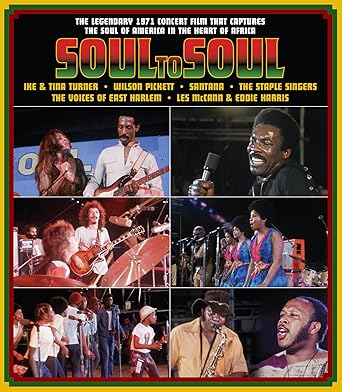
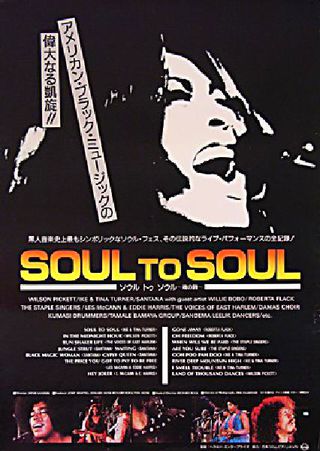
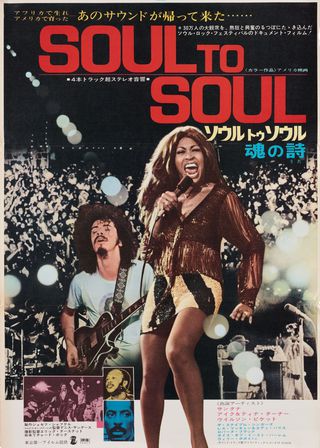
As the popular music documentary got off the ground in the late 1960s and early 1970s, there weren’t nearly as many centered on soul music as white rock music. One of the few from soul’s early ’70s heyday will be re-released May 12 on DVD and, for the first time, on Blu-ray. Soul to Soul focuses on a March 6, 1971 concert in Accra, the capital of Ghana, with a spectacular lineup featuring Wilson Pickett; Ike & Tina Turner; the Staple Singers; Santana; Les McCann & Eddie Harris; and the Voices of East Harlem. It’s not strictly soul, as Santana were a rock band fusing blues, Latin, jazz, and psychedelia, with just one black member; Les McCann & Eddie Harris were more jazz than soul, although their most celebrated song, “Compared to What,” certainly had a lot of soul; and the Voices of East Harlem drew most upon gospel. But it spans a wide spectrum of African-American and soul-influenced music, even if not all of the performers would be filed under “soul” in record stores.
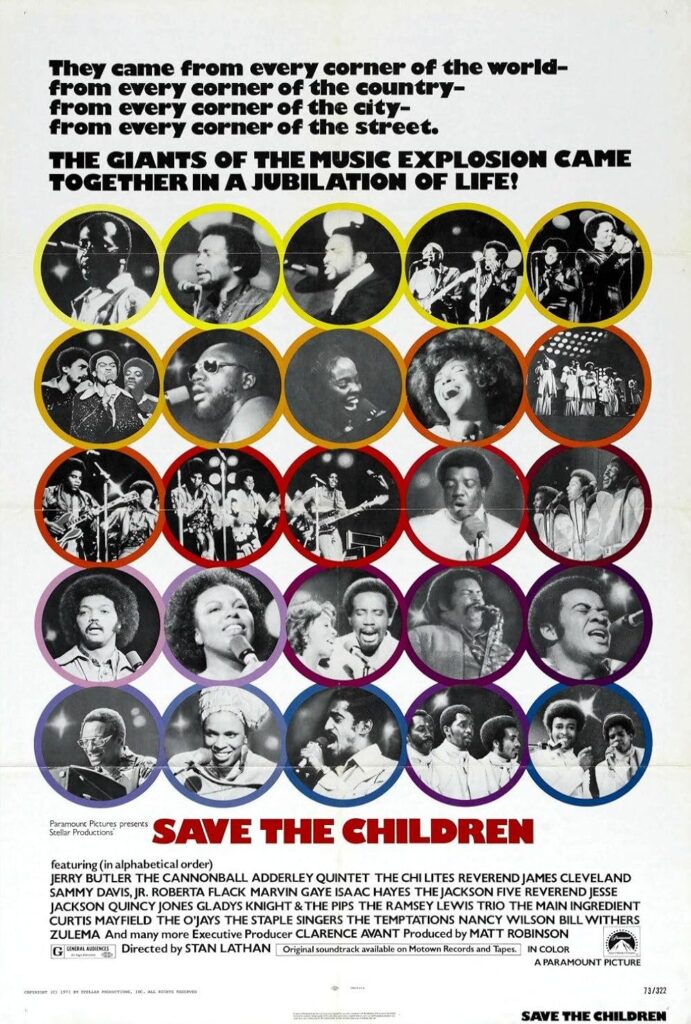
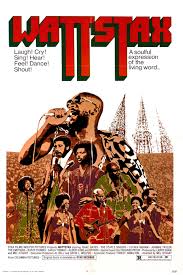
In the early 1970s, just a few other feature-length documentaries showcased soul music. Wattstax, a one-day August 1972 soul festival in the football stadium where the Los Angeles Rams played at the time, featured Stax Records label stars like Rufus Thomas, the Bar-Kays, and Isaac Hayes. The more obscure Save the Children, held in early fall 1972 in Chicago at the PUSH Expo, had a star-studded lineup including Marvin Gaye, Gladys Knight, the Jackson Five, the Temptations, Jerry Butler, and Bill Withers. Soul Power spotlighted a concert held in conjunction with the 1974 heavyweight bout in Zaire between Muhammad Ali and George Forman, with James Brown the top attraction, but also including the Spinners, Miriam Makeba, B.B. King, and Manu Dibango, among others.
Soul to Soul is different from these in its scope, also devoting plenty of screen time to the visiting US performers’ interaction with everyday West African life, whether in markets, with local musicians, or visiting the Elmina Castle, from where Africans were shipped to slavery in the Americas. The approximately 100,000-strong audience, too, was not the usual soul crowd, comprised almost wholly of Africans. Directed by Denis Sanders, the camera operators included some pros who made quite a name for themselves with other movies. Most notably, among the crew were Les Blank (credited as “Leslie Blank”), who made several roots music documentaries and the excellent documentary Burden of Dreams (on the making of Werner Herzog’s troubled movie Fitzcarraldo), and famed cinematographer Vilgos Zsigmond, who subsequently worked on major productions like Deliverance, Robert Altman’s The Long Goodbye, and The Deer Hunter.
The film was co-produced by Richard Bock and Tom Mosk, whose father, Edward Mosk, served as executive producer. The idea originated when Tom Mosk asked James Brown’s management whether they’d be interested in a movie of Brown’s October 1970 concert in Lagos, Nigeria. Although Mosk had equipment and crew to use as he was in Lagos with work on the film Things Fall Apart, Brown’s people didn’t go for it. However, Tom was then inspired to, with the help of his parents, get a concert staged and filmed elsewhere in West Africa. After much negotiation, the concert took place and the Soul to Soul movie was filmed in Black Star Square on the edge of the Atlantic Ocean.
Soul to Soul was not seen by many or widely distributed upon its release later in 1971. In 2004, the Reelin’ in the Years company produced a DVD reissue. Disappointed with the limited promotion of that edition, Reelin’ in the Years president David Peck recently produced it for reissue on both DVD and Blu-ray, taking advantage of the opportunity to restore the film in the process for its 2026 release. There is also a soundtrack (in CD and vinyl formats) featuring music heard in the film, which can be ordered here.
The Reelin’ in the Years archive has 30,000 hours of film, and Peck has produced and/or directed many music documentaries, and was nominated as producer for The American Folk Blues Festival Vol. 1, which compiled performances at European festivals between 1962 and 1966. Reelin’ in the Years were also behind compilations of vintage film performances by British Invasion hitmakers Dusty Springfield, the Hollies, Herman’s Hermits, and the Small Faces, as well as one for the Pretty Things that is included in their Bouquets from a Cloudy Sky box. He spoke to me about Soul to Soul shortly before its 2026 reissue.
Why did Soul to Soul get released now in 2026, after it had been on DVD in 2004?
Arny Schorr of Liberation Entertainment [whose Liberation Hall division partnered with Reelin’ in the Years for the re-release] called me and said, “Hey, we’d like to work with you. What do you have in your archive?” I’d kind of buried this film because it didn’t do well, because of what I feel Rhino [who issued the 2004 DVD edition] did twenty-plus years ago. I said I got this, and all the artists have cleared. I’d love to do it. Once [Liberation] were like “great, let’s do it,” I really got into it. It held a much deeper meaning for me.
What was the deeper meaning?
With the times in which we live, let’s face it, there are certain forces, shall we say, in this country that want to erase the past. I felt this film really reflects an important moment in history. Not just the music, which we love, but general history. To see these artists go to Africa, where obviously hundreds of years before their ancestors had been kidnapped and forced on ships, it was a really emotional experience.
What I love about the film, it’s not heavy-handed. They don’t tell you that, but it’s obvious that’s what it is. From all the commentary tracks that we did twenty years ago, those artists that we interviewed did speak about that. But I think even without that, it’s pretty clear. This is March of ’71, and at that time, the Back-to-Africa movement was very, very big. A lot of African-Americans wanted to go home and discover their roots.
There aren’t too many feature-length films from the time centered around live soul music performances. The only ones I’m familiar with besides Soul to Soul are Wattstax, Save the Children, and Soul Power.
I guess there’s the Isley [Brothers] film from ’69, It’s Your Thing, but that’s just really a concert. Of course, Summer of Soul [the acclaimed 2021 documentary based around performances at the 1969 multi-week Harlem Cultural Festival] that Questlove did. But those are really concerts he turned into something with modern interviews. When it was shot, it wasn’t shot with anything other than, here are some great soul artists, jazz artists, what have you on stage.
This film [Soul to Soul] and Wattstax was an event. Obviously in the case of Wattstax, it was the anniversary of the Watts riots in ’65. Not exactly to the date, but it was the seventh year anniversary. Wattstax was August of ’72, Save the Children was September ’72, and Soul Power—which [was staged around the same time as] the Ali-Foreman fight, rumble in the jungle—was in Zaire, [September] ’74. I think they all have their own unique message. Taken together, those films really do show the culture, certainly the music, of the African-American community at that time.
How is Soul to Soul most different from the other films?
I think Save the Children is really a concert for the most part. There are cutaways to Chicago, there’s the late Reverend Jesse Jackson speaking. But that’s just a really, really amazing concert. You don’t see the audience. It’s a dark room [Chicago’s International Amphitheater]. You see the moment where the Jackson 5 come on and the kids scream, but you really don’t see the audience interacting.
Where in Soul to Soul and Wattstax, there is a give and take. Or to quote Rufus Thomas, a push and pull. But that’s just a really, really amazing concert. Wattstax was a little more than that, although the film, [while] they shot interviews with Richard Pryor and Ted Lange, later of Love Boat fame, again was pretty much just a concert. Again, an amazing concert. But also honoring what had happened seven years earlier in Watts.
Whereas Soul to Soul I think is way beyond merely a concert. Because [of] the fact that these artists flew to Africa, not just to do a concert, but to interact in the local communities in Accra and outside. And obviously, visiting the slave castles in Elmina. I’m not gonna say what film is better, because I think they’re all incredible and have something to offer. But I do think that Soul to Soul is more probably historically significant, in my opinion. Others will obviously perhaps disagree with that, of course. But that’s my feeling, and I’ve obviously watched all of those films.
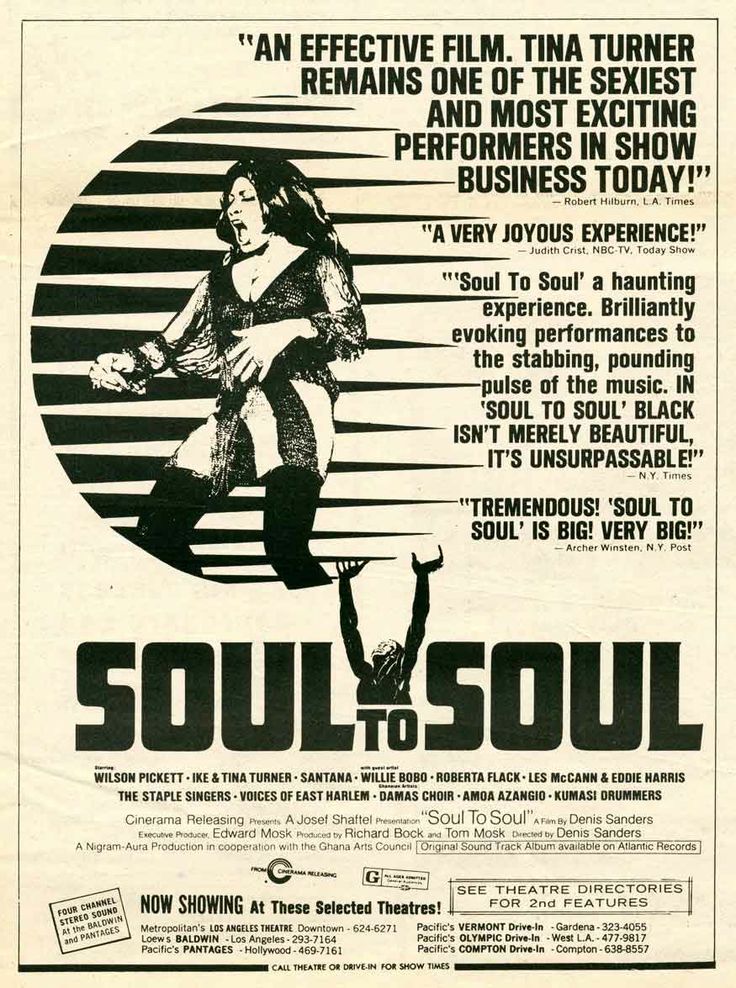
The film wasn’t seen by too many viewers when it was first released in August 1971. Why do you think its run wasn’t more successful?
If you look at the time, it was still pretty splintered musically. Yes, obviously, the Staple Singers were played on white radio when they had hits and stuff. But musically, it was the black community that primarily went to see Soul to Soul or Wattstax or Save the Children. I also think probably studios and the powers that be didn’t see much of a reason to promote it.
Also, and I’m actually thinking about this for the first time ever, Soul to Soul is really pre-Shaft and pre-Superfly. So Soul to Soul predates the blacksploitation genre. Obviously Shaft and Superfly brought that into the mainstream. So perhaps it would have done better had it come out later. I don’t know the answer to that. Shaft was late ’71, ’72, and Superfly was later in ’72.
Could Soul to Soul‘s commercial prospects have been limited by its featuring quite a few scenes of life in Ghana and music by Ghanians, instead of only the performances at the concert?
That’s quite possible. But I don’t think the intention was ever to do that. You heard the commentary where the producer, Tom Mosk, was talking about it. He’s sadly not with us anymore, he died a few years ago; I wish he was here to see the re-release. But he did talk about what their intentions were with this. It never was supposed to be a black Woodstock. It was to bring that music into Africa, because James Brown had turned him down when he’d approached him in Lagos, Nigeria to see about being filmed, because the cameras were there for another event.
I certainly think there’s a National Geographic aspect. But I imagine the filmmakers, certainly the late Denis Sanders, was very deliberate in this. Speaking of Denis Sanders, I think it’s pretty amazing that he directed the film just right after [the 1970 concert documentary] Elvis: That’s the Way It Is came out. Now the movie that’s in the theaters with Elvis [Epic: Elvis Presley in Concert] features outtakes from that film. Talk about Soul to Soul and Elvis in the same year. It is kind of cool.
In your work on Soul to Soul‘s re-release on DVD and Blu-ray, what were the biggest surprises to you?
The biggest surprise was the enthusiasm of the crowds in Africa. I say that because as someone who has for decades now been representing European television stations and all of these great acts that you and I love [who] went over there, a lot of times, audiences are more sitting appreciatively rather than engaged. I’m sure they love it, I don’t mean that they didn’t. It’s just they were more subdued in their reactions.
But these African people in Ghana were just blown away. Imagine if you were in a coma for most of your life, and you woke up right now, and someone played you a Beatles record or something. “Oh my god, what is this?” I imagine for the African community in Ghana at the time, seeing their counterparts—because they’re very well aware of slavery and how their brothers and sisters were hauled away hundreds of years earlier—it was probably an emotional moment for them as well.
So that was something, the intensity and enthusiasm of the African crowds. I guess the surprise was they were able to pull this off in such a short time frame. It’s pretty amazing to stage a concert like that.
There were only a few months between when the idea to film a James Brown concert in Lagos was turned down, which started work on a different soul documentary to be staged in West Africa, until the Accra concert in Soul to Soul took place in March 1971. Especially considering the conditions given for staging the concert and film kept changing during that entire time. The contract wasn’t signed until the day before the show.
The producers went through hell and back. It was kind of what you’d expect in a corrupt government—a lot of shady dealing and promises and grifting and so forth. There are many people whose hearts were in the right place, but unfortunately there were people there at the time that weren’t. The Mosk family were so focused on getting this done, because Tom Mosk’s father, Edward Mosk, was an entertainment lawyer. So he had been battle-tested, so to speak. Maybe not to this extent. But I think he knew how to deal with bullshit in the industry, even if it was the Ghanaian industry. So he was able to pull it off.
I think it is kind of a modern miracle. Wattstax, or Save the Children, or Summer of Soul, those were all in America, in a city. You get permits and a venue. In Harlem it was outdoors; Wattstax was the [Los Angeles Memorial] Coliseum. In Chicago, it was in some auditorium. I don’t imagine that was the difficult part. Getting the artists on board and so forth, and management and whatnot, is the bigger task.
But here, they had to get the artists on board at such a short notice. Fly ‘em to a foreign land, and at the time [Ghana] certainly was not part of the western culture. They were not a major power, shall we say. Getting that taken care of was no easy task.
Some of the especially interesting scenes are the crowd shots during Wilson Pickett’s performance. There are a lot of security officers keeping order, sometimes right in the middle of the audience. Some of them are very stern and poker-faced, but others are grinning widely and really enjoying the concert.
[The way the security officers acted at the Soul to Soul concert] did always stand out to me. I think you see some of that in the closing number, [Pickett’s] “Land of 1000 Dances,” too. They’re trying to sort of control the crowd, but they’re also like with the crowd, and they realize it. They’re looking at the stage at times. I think it’s a beautiful moment. Today a security guard would be fired if they did that, I imagine.
You know what I also noticed? Looking at a crowd of 100,000 Ghanaians, not a fucking cell phone in sight! (laughs) The music was hitting them, and they were one with the stage. The vibe, and the feeling between the audience and the performers.
As Rob Bowman’s extensive liner notes detail, there were a few artists who were approached or considered for the bill, but didn’t appear, like Aretha Franklin, Booker T. & the MG’s, Fela Kuti, and Louis Armstrong. Gospel star Marion Williams signed a contract, but pulled out a couple weeks before the concert. But it seems like the final bill—Wilson Pickett, Ike & Tina Turner, Santana, the Staple Singers, Les McCann & Eddie Harris, the Voices of East Harlem, and Roberta Flack [whose performance unfortunately could not be cleared for the re-release]—were about as good of a lineup as could have realistically been assembled for a project like this.
If I could go back in time—and we’ll exclude James Brown, ‘cause he turned it down—the only two artists that I would have added to the bill—or one of the two, because at that time they were very big—would have been Stevie Wonder or Marvin Gaye. ‘Cause there’s no Motown represented. I’m not saying they didn’t try. Marvin Gaye, could you imagine him doing “What’s Going On” [which was shooting up the charts on the very day of the concert]? Or “Inner City Blues”? Or Stevie Wonder.
Now Stevie Wonder probably wouldn’t have been that well known in Ghana at the time, because [his 1972 LP] Talking Book hadn’t come out. Yes, he had all these great ‘60s songs and whatnot. But I still think Stevie would have been incredible on that stage if he had done it. Although I don’t think he had his band together yet, that band with [guitarist] Ray Parker Jr. and so forth.
An unusual feature of the Blu-Ray/DVD is that it has four commentary tracks. And those have more than four people talking about the film and their roles in it: Mavis Staples on one, Les McCann and Kevin Griffin (of the Voices of East Harlem) on one, producer Tom Mosk on one, and Ike Turner, Santana drummer Michael Shrieve, Ghanaian drummer Obo Addy, and Kevin Griffin again on another.
One we didn’t get a chance to interview, we would have loved to know what Neal Schon [thought. Schon, who along with Carlos Santana handled the guitar parts in Santana’s set, had only recently joined the band, and had only turned seventeen the previous month]. I think this was his first gig with the band, his first major gig. Santana was, I think, the perfect choice. I think if they had gotten the Who, it would have been a terrible choice, as much as I love the Who. If you were gonna bring a group that was not primarily black, they were the group to do it. Because their sound was so steeped in Afro-Cuban sounds.
Santana, I remember Carlos telling me back in 2004, he felt that this is one of the best performances he ever gave. It meant the world to him, this performance. It’s funny, because obviously there’s Woodstock, Fillmore, all those places the original lineup played. But this is really special.
Roberta Flack did just one song onstage in the original film, and that’s not in the re-release as she declined to grant clearance.
With regards to the other part [in which her music was heard], which was the most powerful in the original film, you hear her singing “Freedom Song” in the slave dungeon. It was recorded there.
As you explain in the liner notes, in that scene, “In order to keep the integrity of what I felt was such an important and powerful scene, I came up with the idea of replacing Roberta Flack with Mavis Staples’ moving observations she had described in her commentary track as to what the slaves endured and how visiting the Elmina slave castle deeply affected her.”
Personally, I actually think the Mavis section works better because it gives context to the sequence. I think unless you know the original, people just accept this. [In the original film], you don’t see [Flack]. You just hear her. Those shots in the film that you’re looking at now, those are all in the original film. But if you’ll notice carefully, we had to repeat the shot. Because I needed to extend the sequence out to fit Mavis’s voice.
Wilson Pickett, who arguably is the star of the film in many ways – his performance is killer – he was on board. One day, I got a call from his manager. The manager was great. He goes, “I got bad news for you. Wilson doesn’t want to do it anymore.” I go, “Wait. Why?” “Well, he watched the film and he felt like he wasn’t the star of the film like he’s supposed to be. Ike & Tina Turner open the film, blah blah…if you want to try to convince him, come up with something. Get it to me by tomorrow.”
So I looked at the film. Here was my argument to Wilson: yes, Ike and Tina Turner open the film. But there’s credits all over the screen. But they make a big deal of you coming off that plane. You’re the star there. And guess what, Wilson? The last seven and a half minutes of the film is you. You’re the closer. You’re the headliner. I wrote it in a way where the next day the manager goes, okay, you changed his mind. Here’s a signed contract. So I had to really be a producer at that moment.
So while I don’t take any credit for that original film, I really moved mountains and worked miracles back in ’04 to help get these artists on board. Cathy Carapella [who worked on talent clearances] did most of the heavy lifting. But I had to step in and be creative. And that was one of those times.
There aren’t many DVD/Blu-rays of any kind that have four commentary tracks.
That was all me. [For the previous 2004 re-release], the label fought me. I paid for all of them myself. I wanted to get as much information, history, meat on the bones, whatever you want to call it. It meant the world to me to do that. With Michael Shrieve, Obo Addy, and Ike Turner, I put them all in one track, but in sections where it was relevant. Even now, when Arny Schorr came to me, I said look, I want to keep the original commentary tracks.
I remember when we did Ike, and we recorded this – he actually lived in San Diego. There was a point where it sounded like Ike was crying. He got so emotional talking about his mom; it was during the sequence in the Ghana Arts Council, where they’re all dancing and seeing the local Africans, and singing and dancing and so forth.
That was really powerful. Look, I’ll never defend anything about Ike Turner, ever. But at that moment, in that moment, in the studio, he was human. I want to be very clear, I am not excusing him of anything else that he did. But it was very touching and moving to hear, ‘cause that was genuine.
The film didn’t do well by Rhino [in its 2004 DVD edition], ’cause they just dropped the ball. Wattstax and Soul to Soul[came] out on DVD right around the same time. I remember saying to the A&R department at Rhino, “Hey, I’ve got a really great idea. Why don’t you reach over to [the company who put out Wattstax]. Why don’t we market these together?” “Oh, that’s a stupid idea.” “No,” I said, “these films are bookends in many ways. Anyone who is going to see Wattstaxwould love Soul to Soul, anyone seeing Soul to Soul would love Wattstax.” I could picture the ad in my head, right? They told me I was high. So that was the end of that. It went nowhere. They put no budget into it, nothing.
Speaking of another soul concert film from a few years later that we’ve mentioned, although James Brown’s pretty good in Soul Power, it’s too bad the Mosks couldn’t have done two soul documentaries—Soul to Soul of course, but also the film of Brown in 1970 in Lagos that they wanted to do. That was when Bootsy Collins was in his band on bass, and his brother Catfish on guitar. They weren’t in the band too long, only about a year, and there’s not too much of them playing with Brown on film.
I think Brown was a little past his peak, on record anyway, by the time he did the Soul Power concert in Zaire.
Can you imagine James Brown in August of 1970 in Lagos, Nigeria, even just to hear it?
In one of the commentary tracks, Michael Shrieve says he re-recorded some of his drums for the film’s audio because the sound quality (not the performance quality) wasn’t good on them. Were any other parts redone because of technical issues?
Yes. Because there was something with the electrical current and cycles, there were some tracks that were damaged. For example, I have the multis for some of the Staples. I can see a couple different phrasings of Mavis. But it’s so spot-on, when they did it, they must have been looking at the footage. So someone like Mavis, who’s like almost in a church and just moaning and groaning and shouting and screaming, to re-create that…I don’t know how much was overdubbed. I know some stuff was fixed later, because they had a problem recording. I wish Tom Dowd [legendary Atlantic Records engineer/producer, who mixed the concert’s sound] was still alive to ask him.
There’s just one outtake on the DVD/Blu-ray, which shows Ike & Tina Turner doing “I’ve Been Loving You Too Long.” They also memorably did that in the Gimme Shelter documentary on the Rolling Stones’ 1969 US tour, but this is a complete and yet more explictly sensual version. You write in the liner notes that if anyone has other outtakes, they should contact you. The new edition has only been out for a short time, but has anything like that come up?
Nothing. I still feel like under someone’s bed somewhere, whatever, are those outtakes. Because obviously, they didn’t just film one song. You don’t do that. It kills me to think – you look at Ike & Tina Turner, they filmed the opening [song] “Soul to Soul,” “River Deep Mountain High,” “Ooh Poo Pah Doo,” and “I Smell Trouble.” Well, I’m sure they did more. I wish there were more outtakes, other than that one song. That version is pretty risqué, “I’ve Been Loving You Too Long.” I don’t even have the recording of the whole set. I would be happy if I had that. But glass half full, because thank god we were able to restore the film also. It looked much better than the 2004 release.
Soul to Soul can be ordered through this link.