As more and more archival rock gets unearthed and released, less and less truly different surprises emerge. Some alternate and rough mixes are so slightly variant from the familiar versions that they’re something of an exercise for audiofiles to detect the differences. They’re not such stimulating new discoveries that give you previously uncovered insight into the creation of significant work.
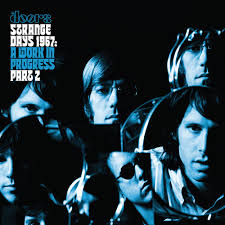
The Doors’ many archival releases have sometimes been cases in point. That includes recent Record Store vinyl LP releases of material from the sessions for their second album, 1967’s Strange Days. Side two of the most recent of these, Strange Days 1967: A Work in Progress Part 2, has backing tracks for “Love Me Two Times” and “Strange Days,” and rough mixes of “People Are Strange,” “Moonlight Drive,” and “We Could Be So Good Together” that don’t make you sit bolt upright as departures from the studio versions. “We Could Be So Good Together” would not be issued on a Doors release until their third LP, 1968’s Waiting for the Sun, and the reason for this isn’t disclosed in the brief annotation for either of these “work in progress” collections.
However, the two alternate takes of “When the Music’s Over” on side one do offer something genuinely surprising. Some of the lyrics are markedly different than they are on the track that ends Strange Days. The song was apparently still evolving, although it had been played live for quite a while, and would reach a notably different finished recorded state after these takes were recorded on April 25, 1967. These are a complete take 1 and an almost-complete take 5, the tape running out on the latter near the end; takes 2, 3, and 4, not included, were false starts.
According to several accounts, “When the Music’s Over” had started germinating onstage in 1966, before the Doors had a recording contract. The earliest available recordings of the song, however, date from quite a bit later, after the Doors’ first album had been released (and before it or “Light My Fire” were hits). Tapes from their stint at San Francisco’s Matrix club in early March 1967 include versions from March 7 and March 10, as heard on the Live at the Matrix 1967: The Original Masters box.
Even at this stage, quite a few lyrics from the final version are missing, and some that were still part of their onstage performances included words not heard on the Strange Days LP. The first three verses of the March 7 version are the same, but after an instrumental break, Jim Morrison ruminates about “something wrong, something not quite right.” A good number of Doors songs mixed poetic/social observations with romantic/sexual ones, and with his gentle urges for a lover to touch him in the night, some of the lyrics that follow (some improvised-sounding) that wouldn’t make the cut for Strange Days fall into this category.
Then eight whole verses are missing. That includes the canceling of a subscription to the resurrection, the face of the mirror, the scream of the butterfly, putting the ear to the ground, the Persian night, the questioning of what we’ve done to the earth, and even the exhortation “We want the world and we want it now!” – the song’s most celebrated lyric, and one of the most celebrated lyrics in the entire Doors canon. So the bulk of the song, lyrically at least, is absent, though space is filled by an extended instrumental break. Jim gets back into semi-improvised-sounding vague romantic musings before reprising a couple of the opening verses.
The March 10 version has a very similar musical arrangement, and likewise goes into musings about “something wrong, something not quite right” after the first verses. Then, however, the words get different and more extensive than the middle part of the one from March 7. There’s confusion, Morrison finding life a bright illusion and torn circus. Some brief mutterings with the word “down” seem influenced by a part of “Moonlight Drive,” and Jim throws in a few vaguely romantic phrases (though different ones than what he employed in the March 7 version) before landing back at the concluding verses. Again, there’s nothing from the eight verses placed on the Strange Days version, and no “we want the world and we want it now!”
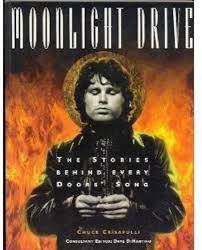
These two recordings suggest the song was in fact quite incomplete lyrically, not long before it was first attempted in the studio. And quite a bit after it was first presented onstage, according to Chuck Crusafilli’s Moonlight Drive: The Stories Behind Every Doors song, which states “they had begun to develop it at their earliest gigs at the London Fog” in early 1966. Maybe the Doors, and specifically Morrison, were floating different ideas for the middle section that could vary between these shows, and their shows in general of the period.
About six weeks later at the April 25 session at the Sunset Sound studio in Los Angeles, the words are yet different and again add and subtract some heard in the final Strange Days track. Again the first three verses are the same as the ultimate version. Some Strange Days LP verses are again missing, but the middle words have altered. “Something wrong, something not quite right” is still present, as is the urge for touch through the night. Then come familiar lyrics, but not from “When the Music’s Over.” Instead we hear, word-for-word, the fourth verse of “Not To Touch the Earth.” That wouldn’t be heard on disc until it was used on Waiting for the Sun, with an entirely different melody than what’s employed on this version of “When the Music’s Over.”
Sometimes melodies heard in early versions of songs by major artists are discarded and recycled in different compositions, sometimes quite a few years later. A home tape of John Lennon writing “If I Fell” from around early 1964, for instance, has a brief wordless scat that would be replicated, note for note, in 1971 when he elongated words at the end of bridges in “Imagine.” Here we have an instance of words being recycled, word for word, but with an entirely different melody, as if Morrison and the Doors realized they were a better fit for the tenser, almost avant-garde “Not To Teach the Earth.”
Then some words surface that aren’t in the Matrix versions, but are on the Strange Days track. The whole verse concluding with the scream of the butterfly is sung, before detouring into quick sensual asides to want someone now and another instrumental break. Crusafilli wrote that the “scream of the butterfly” image came to Morrison when Jim saw an adult theater marquee billing the film The Scream of the Butterfly in Times Square. As it was missing from the Matrix versions, and seems like a striking enough phrase to have demanded permanent inclusion when it first originated, maybe Morrison saw the marquee when the Doors played the Ondine club in New York from March 13 to April 2 – right after their Matrix gigs, and the only time they were in New York between those Matrix shows and this April 25 session.
Then comes an entire verse not in the Matrix or Strange Days versions. Doors engineer Bruce Botnick quotes them in full in his liner notes to Strange Days 1967: A Work in Progress Part 2: “If you had told me that you loved me, you were lonely, I would have stayed for more than a while, tried to make you happy.” These, Botnick speculates in the notes, show “his relationship with his love Pamela [Courson, his main girlfriend from 1966 until his death in 1971] was front and center.”
On a similar take 5, suddenly we hear the verse about the resurrection and house of detention in its entirety. They’re likely too specific to have been an off-the-cuff improvisation, so its omission from take 1 is mysterious. Then follows the verse that would be grafted onto “Not To Touch the Earth,” which likewise was probably not an improvisation as it’s the same as what he sang in take 1. Those quick asides to want someone now and the possibly Pam-inspired verse follow later.
After nine-and-a-half minutes, take 5 suddenly breaks off, though it’s doubtful it had different lyrics at its conclusion than take 1 did. That’s a strange quirk. As Botnick writes in his notes, producer Paul Rothchild is heard (though not very distinctly) wondering if the reel is long enough to record the entire song. Indeed it wasn’t. Was tape so scarce that another reel with enough space couldn’t have been used? Everyone certainly knew the song was ten minutes or a little longer. And while “Light My Fire” and the first Doors album were a couple months away from entering the Top Twenty on their way to the top of the charts and making them one of the hottest groups in the world, certainly these sessions weren’t a low priority for Elektra Records. Their underground following was already mushrooming, and sessions for a second album already green-lighted and well on the way.
It’s not known when the final version of “When the Music’s Over” was recorded. Maybe it was as much as a few months later, the album not getting released until September 25, 1967. Certainly these takes demonstrate that a lot of work went into refining the song before it took its final shape, “We want the world and we want it now!” and all. As Botnick writes, “After this session, and being that the Doors were very much a performing band, we wanted ‘Music’s Over’ to have the excitement of a live performance. So it was decided to further woodshed the song out of the studio and allow [Morrison] to settle upon the story he wanted to tell.”