With more than a quarter of the 21st century gone, reissues of rock from the mid-to-late twentieth century continue to emerge in just as much quantity, and maybe more. In common with recent years, 2025 saw a wealth of archival releases mixing compilations of unreleased material and re-releases of officially available music garnished by rare and unissued tracks. Also in common with recent times, the balance has shifted toward bigger and more expensive packages built around recordings that many fans of the artist will already have, with rarities added to incite purchase. It’s not the greatest value for those fans who don’t have a ton of disposable income, but labels and artists will keep doing it as long as the market supports it.
Some of the titles on this list of my favorite reissues of the year fall into that category of “wish I could just pay for the stuff I don’t have,” sometimes irritatingly so. But there are still a good number of compilations offering wholly or mostly unreleased stuff, as well as some of acts never before compiled into album form, such as Jeannie Piersol. The number of actual albums from the past worth hearing that were previously unknown to me before getting reissued continues to dwindle. But the growing shortage of previously unheard music does seem to spark record companies, artists, scholars, and just plain fans into working ever harder to uncover worthwhile vault finds.
I had substantial involvement with three of the records on this list, in one case especially heavy involvement. I hope that I’ve given them rankings that accurately reflect the regard in which I hold them, irrespective of my professional work on them. If it’s felt that such work renders my rankings of these biased, I’ve marked them with two preceding asterisks as red flags.
** — denotes releases in which I was professionally involved as a writer of liner notes and/or compiler.
**1. Lamb, An Extension of Now: Unreleased Recordings 1968-1969 (Real Gone). I not only wrote the extensive liner notes for this compilation, but also was involved with the track selection and sequencing. As I was heavily involved in this project over a period of five years, from the time I was made aware of these tapes (preserved by Lamb guitarist-songwriter Bob Swanson) until these found official release, I might not be the most objective evaluator of its merit on a best-of list. Still, I wouldn’t have been as heavily involved had I not thought the music both historically important and highly worthwhile on its own terms.
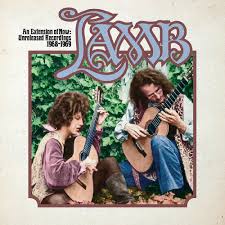
As some background, on their early-‘70s albums A Sign of Change and Cross Between, Lamb offered some of the most intriguing and eclectic music of any San Francisco rock band on the psychedelic scene. Arguably their blend of rock, folk, classical, country, blues, and gospel was as hard to classify as any of the era. With guitarist and songwriting partner Bob Swanson, Barbara Mauritz’s versatile vocals paced material imbued with a haunting, mystical aura. Yet they could also be earthy and rootsy, occasionally drifting into spacey psychedelia with hints of raga-rock.
This record captures the group at an earlier, sometimes folkier, yet fully realized stage. A few of these songs were redone for their LPs, albeit in substantially different, usually more fully produced versions and arrangements. Most of these, however, were not included on these or any other Lamb releases, and those songs are largely on par with the material that did get on their albums. That haunting, mystical acid-folk feel is yet more pronounced than it is on their first pair of LPs. Yet there’s also some down-to-earth blues with “Barbara’s Soul,” and out-and-out hypnotic raga rock on the standout lengthy closer, “La Plaza De La Paz.” Raga rock also factors into a couple tracks here by a group from which Lamb evolved, the Learning Process, recalling some of the work done along those lines by the Great Society.
2. Patti Smith, Horses 50th Anniversary Edition (Arista). The first disc of this double-CD release isn’t strictly necessary if you don’t thrill to the emergence of remastered editions of familiar albums. In this case, Horses, Smith’s debut album, is very familiar, and likely to already be owned in one or more formats by most fans purchasing this disc. However, the bonus tracks comprising all of disc two are genuinely and simultaneously interesting and actually enjoyable to hear as an album of sorts of its own. Just one of the nine tracks (an alternate of “Redondo Beach” that came out somewhere—the liner notes don’t explain where) was previously released. All of the others are previously unissued studio tracks spanning February 6, 1975 to September 1975.
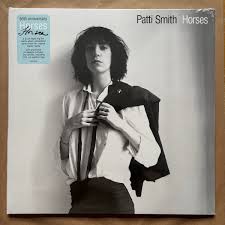
Four of those (“Gloria,” “Birdland,” “Kimberly,” and “Break It Up”) are alternate versions of songs that did make the LP; the other four (“Snowball,” “Distant Fingers,” “We Three,” and a cover of the Marvelettes’ “The Hunter Gets Captured By the Game”) didn’t. To my knowledge (any corrections gladly accepted), “Snowball” and “The Hunter Gets Captured By the Game” haven’t appeared on any other official releases, though live versions from a May 28, 1975 radio broadcast have long circulated on bootleg. “Distant Fingers” was redone for her 1976 Radio Ethiopia album, and “We Three,” heard here in a February 1975 recording, for 1978’s Easter.
Scorecard keeping aside, what’s most important is that these are fine performances, and in some ways significantly different from what you hear on Horses, though essentially similar. Of most importance, the three tracks from February 6, 1975 at RCA Studios and the two from May 27, 1975 at A-1 Sound Studios don’t have drums, giving them a more unplugged feel with more emphasis on Smith’s poetic qualities. That doesn’t mean they’re better or equal to the familiar Horses versions, but they’re worth appreciating in their own right. “Snowball” shouldn’t have been disqualified from Horses for lack of merit, though maybe it was simply felt there wasn’t enough room; it’s a nice haunting, moodily dramatic piece, perhaps with more roots in her roots as a spoken word poet than most of the material that made Horses. “The Hunter Gets Captured By the Game” isn’t as essential, but it’s okay, and comes off better than you might expect from a Smith Motown cover.
The four alternates of songs from the LP, recorded in September 1975 at Electric Lady Studios, all seem to be from sessions for the album itself, and are respectable if perhaps more subdued and less full than the final versions. While there’s a brief and expectedly stream-of-consciousness liner note by Smith, some more details about the bonus tracks other than their dates and locations would have been welcome.
3. Françoise Hardy, Blues: Intégrale Vogue 1962-1967 (Vogue/Sony/Legacy). In what will have to be a complicated and lengthy assessment of this box set, let’s start with the title. Hardy, for all her great attributes, wasn’t a blues singer, and nothing here fits that description, unless that refers to a blue or melancholy mood. The translation of the title is “Complete Vogue 1962-1967,” insinuating that this has everything she recorded for the French Vogue label during those years. It has most of it (which is a lot), but not every last thing. Also, there was a four-CD Hardy box titled L’Integrale Disques Vogue 1962/1967 with 83 tracks back in 1995. This has eleven CDs with 217 tracks, along with a DVD with 59 performances. How could there be so much more material, and how could it miss anything?
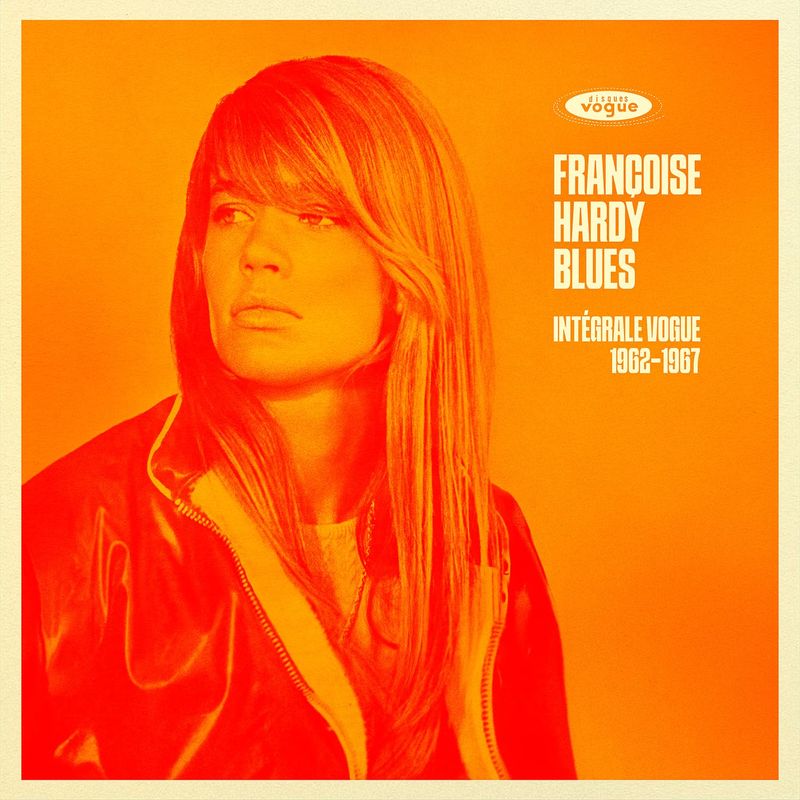
Hardy recorded in several different languages (though principally in French), so there’s a disc apiece for her work in English, Italian, and German. Often, especially when recording in English, these simply use the same backing track as the French versions, with a different-language vocal. However, occasionally these include songs with no French counterpart, though these tend not to be as good as those with French prototypes, a la “Catch a Falling Star” in English, or some of the German songs, which recall the middle-of-the-road schlager genre. Yet some of the songs originally done in French have noticeably different backing tracks, like the Italian version of “Le Temps de L’Amour.” And some of the songs without French counterparts have their merits, like Italian “La Tua Mano,” with its inviting European pop orchestration.
There’s also a disc of rare recordings, starting with two songs from a 1961 audition for Vogue in which the promise that would soon flower is rather bare, especially as the guitar accompaniment is ukulele-thin on those and some early TV performances. The outtakes on this disc are pretty good overall, including a much different, more heavily orchestrated version of one of her more famous songs, “Mon Amie La Rose,” and the 1964 Hardy original “Tu Es Partie,” a typically fetching brooding orchestrated recording that certainly deserved release at the time. The atypically breezy but good “La Mer” only appeared on a 1965 German LP (though it’s sung in French), though this isn’t noted in this box’s annotation. “Ce Petit Coeur” has a different, somewhat more rock-oriented arrangement, and a 1967 duet with romantic partner Jacques Dutronc rocks much harder than virtually anything else she did at the time. Hardy might sing somewhat better in Italian than English, and better in both languages than she does in German, but she was competent no matter what the language. And her English recordings do include her one significant hit in English-speaking markets, “All Over the World,” which made the UK Top Twenty in 1965.
There’s a disc apiece dedicated to her five French LPs during this period, each of them augmented by bonus tracks taken from non-LP Vogue releases and some alternate takes and live recordings. (Again the notation could have been more specific as to the exact sources of the non-LP cuts, and what was previously unreleased.) The live material is more nice than essential, as it lacks the full production of the studio versions, but it’s enjoyable to have. There are also some alternate versions you might have missed—the EP version of “Si C’est Ça,” the single version of “Et Meme” (which is quite different from the more familiar, stomping girl group-like one), and an alternate and worthy version of “Le Temps De L’Amour,” one of her greatest recordings, with different guitar flourishes.
That brings us up to nine CDs. What of the other two? They’re in the double CD labeled Remixes. What makes the remixes of these fifty songs, spanning her entire time at Vogue, different from the original or more familiar ones? It’s not revealed, though the annotation for this box is fairly extensive. These do sound good (and not very noticeably different from the mixes I’m used to), but in common with many a reissue, these tracks smack of adds-on to bolster the list price.
A big bonus, however, is the DVD of 59 TV performances from 1962-1967. These are in fine fidelity and image quality, and while the settings are sometimes silly (especially in a few where a guy futilely wrestling with Hardy posters seems to be a running gag), she always looks sensational and poised. The letdown is that except for the very first clip (“La Fille Avec Toi,” from February 1962), all of them are mimed to the records.
The 56-page booklet has extensive, if not quite definitive, liner notes in both French and English, with plenty of photos, vintage record cover reproductions, session sheets, and tape boxes. Each of the CDs is housed in gatefold sleeves that reproduce the covers and liner notes for the discs representing the original LPs. The track listings include chart positions for all the songs that made the charts, not just in France, but in many countries, including Japan, Brazil, South Africa, Belgium, and Canada, though not including the US, where she had no chart entries, though much of her material had American release.
The main attraction, however, is the music, which stands as the best French pop not only of the era, but of all time. The melodies, in songs often written by Hardy herself, are grand and often though not always bittersweet and haunting; the production often lush and imaginative, whether orchestral or not; the vocals unremittingly sensuous; and the range of stylistic elements wide, taking from Continental pop, early-‘60s teen idol music, mod rock (particularly on her Charles Blackwell-produced mid-‘60s sessions in London), girl groups, folk, and even some dabs of country music here and there. The quality isn’t always super high, but it often is, and there’s little filler, encompassing an extraordinary amount of fine and diverse music that is almost always at the least pleasant, and frequently magnificent. Even the kind of corny pseudo-rock backing on some of her early-‘60s sides has its charm. The rarities (as they are in many big boxes) might not generally be up to what was in common circulation in the 1960s, but they’re worth hearing. So what’s not to like?
Any big box that represents itself as the “complete” of anything should be complete, not incomplete. And this is missing two tracks that were officially released on Vogue in 1967, “Voilà” and “Qui Peut Dire.” Any omissions from a box like this are serious, but their absence isn’t trivial. “Voilà” was one of her most spectacular recordings, with wall-of-pop-rock orchestration and intensely emotional vocals rivaling the best of Dusty Springfield’s releases of that sort. “Que Peut Dire” is also very good, verging on moody folk-rock. This box does have the Italian version of “Voilà,” and the studio recordings are used for the soundtrack of the film clips of “Voilà” and “Que Peut Dire” on the DVD. But that doesn’t excuse the absence of the original studio recordings from the CDs, which a reviewer on Amazon France correctly pegged as “impardonnable.” Roughly speaking, it’s kind of like omitting “Let It Be” and “Don’t Let Me Down” from a complete Beatles box.
How serious is the absence of “Voilà” and “Que Peut Dire,” even though both titles have been issued on other CDs? It’s serious enough to knock this box out of consideration for the #1 spot on this list.
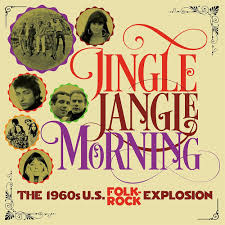
**4. Jingle Jangle Morning: The 1960s U.S.Folk-Rock Explosion (Grapefruit). As the author of a two-volume book history of 1960s folk-rock, I’m well aware prime 1960s folk-rock could fill a box of a dozen CDs, even being selective. I know, from having assembled and written the 10,000-word liner notes for this three-CD, 74-track compilation, how difficult it is to license some prime material. Still, in my biased opinion, this is a good mix of hits and rarities, and big names with cult names and unknowns, spanning folk-rock’s 1965-70 prime (with a couple slightly earlier cuts). There are a bunch of big names/hits here, from originators the Byrds and Bob Dylan through Simon & Garfunkel, Jefferson Airplane, Buffalo Springfield, and Judy Collins. There are also a bunch of artists you won’t find on other compilations built around this theme, from the Blue Things and Jesse Lee Kincaid to the Lemon Drops and Stourbridge Lion. And there are important non-superstars like Love, Phil Ochs, and Fred Neil; underrated groups like the Great Society and Fapardokly; and detours into folk-rock by well knowns that are known for different styles, like Johnny Winter, Nico, and Big Brother & the Holding Company. The list could go on for a long time, and you can see the entire one athttps://www.cherryred.co.uk/catalogsearch/result/?q=Jingle+Jangle+Morning. To end this commercial, you can also still read about 1960s folk-rock in depth in my ebook Jingle Jangle Morning, which combines my Turn! Turn! Turn! and Eight Miles High books into one volume, with updated/extra material.
5. Evie Sands, I Can’t Let Go (Ace). Sands was a fine pop-soul singer, but had some bad luck with record labels and other artists doing more popular versions of some songs she did first. In particular, those songs were “Angel of the Morning,” a big hit for Merrilee Rush (and a substantial one in the UK for P.P. Arnold); “I Can’t Let Go,” a big 1966 UK hit for the Hollies (almost making the US Top 40); “Take Me for a Little While,” covered quickly by soul singer Jackie Ross and done by a few big names, most notably Dusty Springfield and Patti LaBelle & the Bluebelles; and perhaps “Picture Me Gone,” done by Madeline Bell on the B-side of her hit “I’m Gonna Make You Love Me.” The versions that appeared on 1965-67 singles by Sands (as well as her remake of “Take Me for a Little While” from a 1970 single) are all on this 26-track collection, which has all of the sides she released on 1963-70 singles, some of which have been quite hard to find.
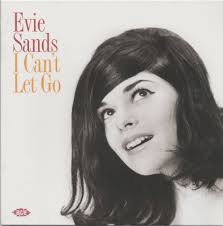
While Sands’s versions of the aforementioned songs aren’t necessarily the best, they’re good and notably different from the more familiar ones. There is, however, a notable gap in the quality of the compositions (though not her vocals) between the best of these songs and most of the others. The four cited above are clearly the best of the tracks, most of which were produced by the team of Al Gorgoni and Chip Taylor, who also wrote many of the songs (usually together, though Taylor wrote some alone, including “Angel of the Morning” and “Any Way That You Want Me,” which had been a big UK hit for the Troggs before Sands recorded it). The material’s usually decent, however. If the arrangements sometimes verge on the overly lush, the tracks occasionally approach the better known tunes in worthiness, especially the intense 1966 B-side ballad “It Makes Me Laugh.” The sole number written by Sands, the 1970 B-side “It’s This I Am, I Find,” is a woozy mystical-tinged orchestrated ballad that makes one wish there was more self-composed work from this era. The liner notes include extensive comments on the songs from Sands (and a few from Taylor), and even give specific details about the few film clips of Sands from this period that can be found.
**6. Jackie DeShannon, Love Forever: Demo Recordings 1966-68 (Real Gone). And here’s another project where I wrote extensive liner notes, these based on a lengthy recent interview with DeShannon yourself. Again, I hope its inclusion on this list reflects my honest enthusiasm for the music, and not promotion of a project in which I participated. The terrifically talented singer-songwriter made a lot of demo recordings in the 1960s that only or primarily was made available on rare LPs only circulated within the industry, for publishing purposes. Only one of these sixteen tracks was actually officially released in the 1960s, and although five others eventually surfaced on archival compilations, they’re not exactly well known. The other ten make their first official appearance here, though a more orchestrated version of one highlight, “Nicole,” appeared on her 1968 LP Me About You.
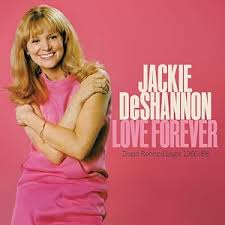
More important than their rarity (and certainly more important than my participation) is their quality. Recorded in 1966 and 1967, these sixteen cuts illustrate her transition from the pop-rock and folk-rock of her early-to-mid-‘60s work to the singer-songwriter school she’d help pioneer near the end of the decade, putting quite a bit of soul in the mix as well. Much can in retrospect be seen as a bridge between that a mid-‘60s demo LP (still unreleased) of her folkiest side and her emergence as an early pillar of the Los Angeles singer-songwriter movement on her 1968 Laurel Canyon album. Although the sixteen demos featured on this album cover a relatively short period in DeShannon’s lengthy career, they encompass several styles—soul and pop perhaps more than any others, but also strands of both traditional and contemporary folk, and echoes of country and blues.
7. Various Artists, Viva Doc Pomus: Songs for Elvis (The Demos) (Omnivore). This double-LP vinyl Record Store Day collection has demos of thirty songs Doc Pomus co-wrote, mostly though not always with Mort Shuman, that were recorded by, pitched to, or likely pitched to Elvis Presley. The title’s slightly misleading, and not only because most of the compositions are credited to both Pomus and Shuman, who together wrote many rock’n’roll hits in the late 1950s and early 1960s, including records by Elvis, the Drifters, Dion & the Belmonts, and others. Although Pomus had an interesting and fairly extensive career as a singer and recording artist before he became primarily known as a songwriter, he didn’t actually sing any of the demos here. Most were sung by Shuman, sometimes with a pretty-Presley-like delivery; one (“I Walk the Muddy Road to Love”) was sung by Peter Anders; and five were sung by unknown vocalists.
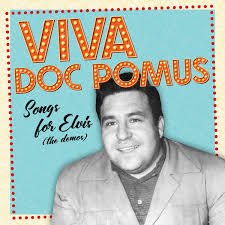
While this is arguably about as much a Shuman album as a Pomus one, that’s not really worth arguing about, since the record’s pretty interesting. It’s also more enjoyable than you might expect, since such demo collections are often more of historical than entertainment value. The songs Elvis did record include some big US and/or UK hits, among them “(Marie’s the Name) His Latest Flame,” “She’s Not You,” “Viva Las Vegas,” “Kiss Me Quick,” “A Mess of Blues,” and his standout non-hit “Suspicion” (which was a hit for Terry Stafford). While these generally and unsurprisingly don’t match Elvis’s versions, they’re surprisingly good and spirited, and while the production’s basic, it’s usually not merely threadbare. A particular standout is the compelling minor-key “Gonna Get Back Home Somehow,” which Elvis did put on the Pot Luck soundtrack in 1962, though this Shuman-sung demo is more menacing and actually better.
While the other songs don’t include tunes to match these highlights, they’re generally above-average early-‘60s-style rock’n’roll, often if not always with a bluesy feel. Intriguingly, a number of these were intended to be soundtrack themes to the Elvis films Pot Luck, Clambake, Easy Come Easy Go, and Kissin’ Cousins, but not used, as other songs with the same titles were chosen—though all of these would have probably been better picks. A few were used as Elvis movie themes—“Viva Las Vegas,” of course, and also Double Trouble and Girl Happy. Also of interest are a couple songs written with Elvis in mind, but which ended up being hits for Fabian, those being “Turn Me Loose” and a very short, rudimentary “I’m a Man.”
A few months after its release, the tracks on this vinyl edition were made available as one of six CDs in the Doc Pomus box set You Can’t Hip a Square: The Doc Pomus Songwriting Demos. To my knowledge, the future availability of this material in this format was not made public at the time of this Record Store Day release. That’s a considerable frustration, as it is in other cases like David Bowie’s 1969 rarities, for those of us who are okay with waiting for the CD version to save considerable money and repetition in our collections. As this review was written before I knew about the box, and this double LP does contain the best material on that box, I’m leaving the review in this listing, reviewing the box as a whole in a later entry in this list.
8. Jeannie Piersol, The Nest (High Moon). Although her discography only totaled two rare late-‘60s singles, Jeannie Piersol was a figure of note in the psychedelic San Francisco scene. She was briefly in the Great Society alongside Grace Slick, though that only lasted for a few early rehearsals before she became lead singer of the Yellow Brick Road. She reconnected with the Slick clan in the short-lived Hair, who also featured ex-Great Society guitarist Darby Slick. Darby was also on some tracks (which he also produced) she cut for Chess’s rock-oriented Cadet Concept division, resulting in her pair of 45s.
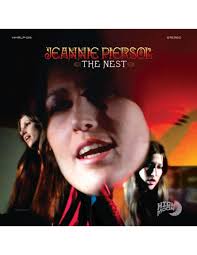
Besides both sides of those singles, this compilation adds a couple outtakes from the Chess sessions; a couple 1967 Hair demos; a couple Yellow Brick Road tracks, taped live at San Francisco’s Matrix club in March 1967; and a couple unreleased Slick-produced cuts from 1968 with another Great Society veteran, Peter Van Gelder, on flute and bass. Darby’s brother Jerry, who’d been the Great Society’s drummer and filled in for a couple weeks with the Yellow Brick Road, even filmed a promotional video for “Gladys” that can be found online.
Piersol wasn’t just a vehicle for Great Society alumni, however. She wrote the majority of the songs here, Darby Slick writing the other four. She also sang with a strident power that might invite some comparisons to Grace Slick, though the similarity is casual rather than derivative.
Certainly the standout is the Piersol-penned single “Gladys” (an earlier Hair demo is also included), which happens to have the strongest resemblance to Grace Slick performances like those heard on Jefferson Airiplane’s “Two Heads” and “Lather.” Given the Great Society connections, it’s no surprise there’s often an Indian flavor to the melodies and arrangements, Darby Slick playing some sarod, and Piersol getting into some raga-esque vocal twists on “Joined in Space.”
Piersol and her bands, however, are set apart from the Great Society with a blend of raga rock and pure soul. Chess stalwarts like drummer Maurice White, guitarist-bassist Phil Upchurch, arranger Charles Stepney, and singer Minnie Riperton helped out on her Cadet Concept sessions. These sometimes resulted in what compiler Alec Palao terms an “Indo-rock-soul hybrid” in his liner notes. While that might sound like throwing too much in the stew, it works pretty well, also setting her apart not just from other acts in the crowded San Francisco scene, but even from most others working in psychedelic rock anywhere.
Palao did his usual heroic job in filling in a missing chapter in 1960s San Francisco rock by finding and assembling an entire Piersol album. His lengthy liner notes also feature recent memories from Jeannie herself, as well as extensive comments from some members of the Yellow Brick Road and Hair, whose horn player, Terry Clements, went on to play with Janis Joplin’s Kozmic Blues Band, the Electric Flag, and the Buddy Miles Express. (This review previously appeared in Ugly Things.)
9. The Final Solution, Just Like Gold! Live at the Matrix (High Moon). One of the earlier San Francisco psychedelic-era groups, the Final Solution never put out a record during their brief lifetime, spanning approximately late 1965 to mid-1967. While much (and maybe all) of this material has circulated unofficially for a long time, this marks its first truly above-board release, in better sound than previous incarnations. Ten of the sixteen tracks were recorded at San Francisco’s Matrix club in July 1966; the other six come from a November 1966 rehearsal. By that time they had a connection with a much bigger San Francisco act, as Grace Slick’s then-husband, Jerry Slick, was on drums, though he doesn’t appear on the Matrix recordings. Jerry had been in the Great Society, the fine pioneering San Francisco psychedelic group also featuring Grace and his guitarist brother Darby.
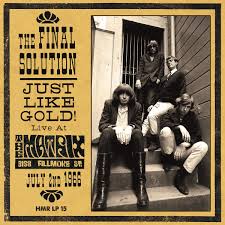
Even before Jerry joined, the Final Solution bore some similarity to the Great Society with their use of minor-key, sometimes raga-shaded melodies. They even lifted parts of the Great Society songs “Arbitration” and “Father” for passages in their own, largely original repertoire. The similarities didn’t go too far, however, and not only because they had less of an Indian influence. The songs were almost unremittingly dark, even dour. They were also often too similar to each other to put the band in the same league as the Great Society or the best early San Francisco rock acts. The musicians themselves didn’t seem to expect much in the way of recognition, judging from somewhat self-deprecating comments by members in Alec Palao’s liner notes that also express a lack of ambition compared to the scene’s heavyweights.
Still, for aficionados of the early San Francisco Sound, this is a notable supplement to that scene’s pre-1967 recordings, even if they also weren’t in the same league as their top peers instrumentally or vocally. There’s an appealingly raw, near garage rock vitality to their downbeat early psychedelia, best heard on “Bleeding Roses,” “If You Want,” “Misty Mind,” “Just Like Gold,” and their odd mutation of “America the Beautiful.” The recordings with Slick aren’t too markedly different from the live Matrix cuts in nature or quality, including different versions all the aforementioned songs except “America the Beautiful,” and a couple originals not captured on the Matrix tape.
10. Nick Drake, The Making of Five Leaves Left (Island). Drake made just three albums, but now the archival releases of tracks unissued in his lifetime far exceeds those three LPs in quantity. The amount of archival material increased substantially with this four-CD box set, three CDs of which (containing 32 tracks) were previously unissued. The fourth CD is Five Leaves Left itself, Drake’s 1969 debut album. The three other discs have studio outtakes, most of them alternate versions of songs from Five Leaves Left, spanning later winter 1968 to early spring 1969, along with eight songs from an informal 1968 non-studio tape in arranger Robert Kirby’s Cambridge dorm room that’s of fairly low but listenable fidelity.
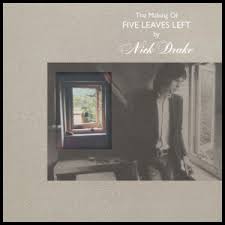
While acknowledging that the purpose of this box is to illustrate the evolution of and path to an album rather than present recordings that are consistently on the level of the final product, the previously unheard cuts do largely fall into the category of “as much historically interesting as exciting listening.” The differences between the studio outtake versions and those heard on the final LP are usually not huge, though it’s pleasant to hear the songs in somewhat different arrangements that are usually less elaborate than those on Five Leaves Left. Like many such historical boxes, it does illustrate how polish and production touches elevating the final versions to substantially higher quality. There aren’t many truly striking variations, an early take of “‘Cello Song” (then called “Strange Face”) standing out with its absence of cello and inclusion of what sounds like steel drum patterns, perhaps played on piano. The early take of “River Man” doesn’t have the dramatic orchestration on the familiar Five Leaves Left arrangement, as another example.
As for songs that didn’t make the LP, “Mayfair” is okay if perhaps atypical in its Donovan-ish upbeat observational flavor. Just three of the eight songs from the dorm room tape (“The Thoughts of Mary Jane,” “Day Is Done,” and “Time Has Told Me”) would make Five Leaves Left, though one (“Made to Love Magic”) would be recorded as a studio outtake in 1968. The other four are okay but not up to the same standard, again showing more of an early Donovan feel than his studio releases would exhibit. Drake’s skills on guitar—sometimes it’s hard to believe just one person was producing such a full sound—are in abundant evidence on most of the outtakes, even on the half-dozen tracks from his first studio session in late February/March 1968.
With an LP-sized 60-page booklet featuring detailed liner notes, production details, lyrics, photos, and tape box productions, the extras are elaborate, but not without their flaws. The liner notes mention a take 2 of “The Day Is Done” from April 22, 1968 being included on the set, but the detailed graph showing tracks and production details does not list it, or indeed anything from the April 22 session written about in the notes. (The April 22 reference was a typo; the correct date is April 11.) Some photos are dated differently in the liner notes and the captions. The music on the three CDs of unreleased music, adding up to about two hours, could have easily fit onto two discs. The CDs are encased in four different LP-sized cardboard sheets that are in turn placed in LP-sized sleeves, all bearing the same cover (the final one used on Five Leaves Left), and aren’t all that convenient to access and pull in and out of their slots. If that contributed to the high list price, the fussiness was certainly unnecessary.
Note too that a number of tracks from this period, some of them detailed in the liner notes, are not included on this box. There’s no need to panic, as they’ve been available for decades on the Time of No Reply compilation, though it would have been useful for the box annotation to note this.
11. Judy Collins, The ‘60s Singles (Elektra/Real Gone Music/Second Disc). Usually and justifiably thought of as primarily an album-oriented artist, Judy Collins had more singles, and more success with 45s, in the 1960s than many realize. “Both Sides Now” was a Top Ten hit in 1968, of course, but she had four other entries in the Top 100. All fourteen of the tracks that appeared on her singles in the decade are collected here in their original edits and mixes (most notably “Both Sides Now” in the dedicated mono mix on its original pressing), almost amounting to a 1960s best-of.
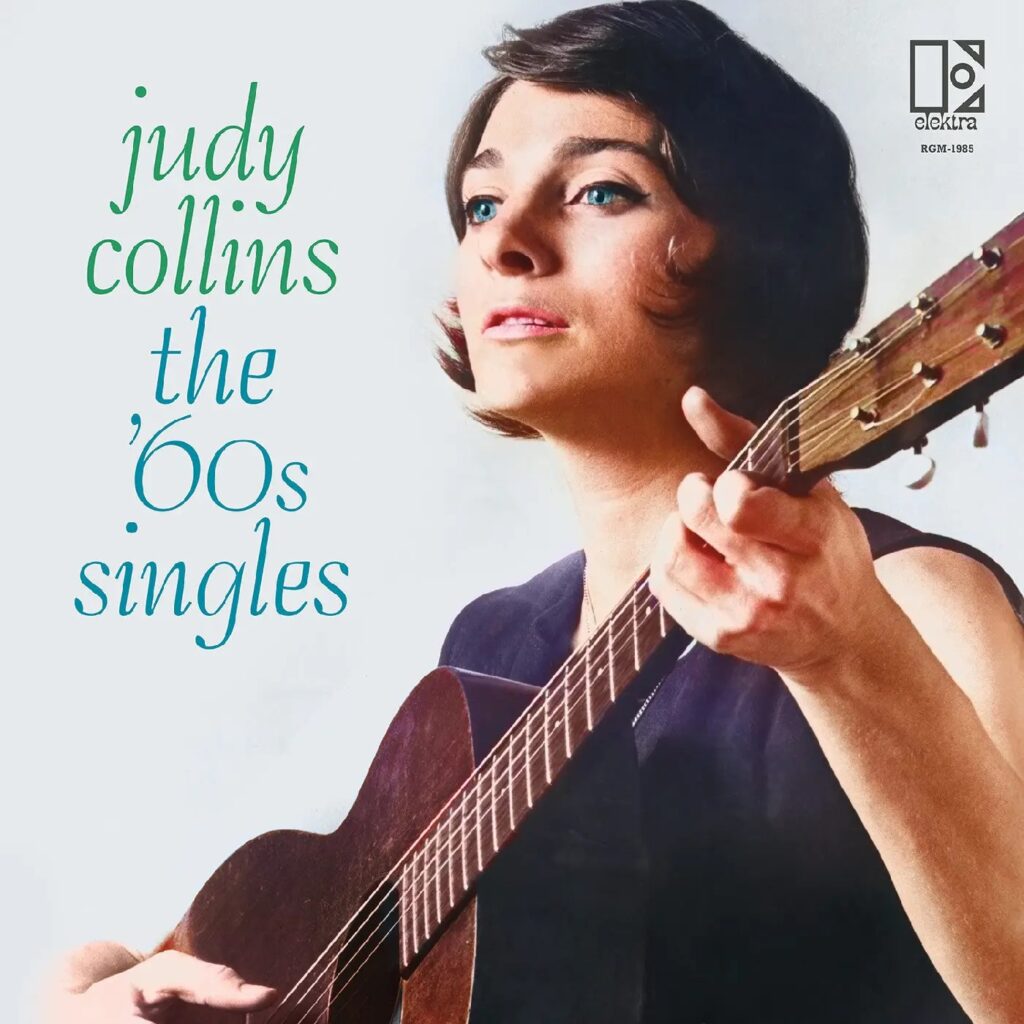
For Collins completists, the most noteworthy tracks are those that didn’t appear on LP or are different than the album versions. There’s the 1965 non-LP B-side cover of Bob Dylan’s “I’ll Keep It With Mine,” a song Dylan didn’t release himself in the 1960s, though mid-‘60s outtakes he cut appear on archival compilations (and Nico and Fairport Convention would do it later in the decade). Collins was first, and its appearance marked her first venture into folk-rock, helped by Dylan sidemen Al Kooper on organ and Mike Bloomfield on guitar. It did make it onto the 2005 various-artists CD compilation Great Lost Elektra Singles Vol. 1 and 2006 box Forever Changing: The Golden Age of Elektra Records 1963-1973, but it regains easy access here.
A little surprisingly, her ornately baroque-folk-rock version of Joni Mitchell’s “Chelsea Morning”—issued about a year after Judy’s take on Joni’s “Both Sides Now” was a hit—didn’t make it onto LP (or too high in the charts), though a live version would be on Collins’s 1971 album Living. The Sandy Denny-penned “Who Knows Where the Time Goes” was the title track of Judy’s 1968 album, but even Collins collectors might not know the version on the B-side of “Both Sides Now” (also appearing on 1972’s Colors of the Day: The Best of Judy Collins) was an entirely different recording. Much more sparsely produced than the LP version—almost to the point that it sounds like a demo for the album rendition, instrumentally dominated by guitar strums—it’s here and well worth hearing.
Collins’s first single, her graceful take on Pete Seeger’s “Turn! Turn! Turn!,” appeared on her third album in 1963 before getting issued on 45 the following year. It’s mostly forgotten that Elektra put it out again as a single in 1969 and got a small hit when it rose to #69 on the charts. Even more forgotten is that the 1964 single was about 45 seconds shorter, removing the second verse. Both the 1964 and 1969 single versions are here.
Those are the four tracks that will most attract collectors, but the high quality of the rest of the set also marks Collins as one of the top folk and folk-rock singers of the 1960s (though the “rock” in her folk-rock was of the mild variety). The uncommonly forceful interpretation of Richard Fariña’s “Hard Lovin’ Loser,” with its urgent harpsichord riffs and barrelhouse piano, should have been a much bigger hit, though it did mark her first chart entry when it peeked into the Top 100 at #97. Other highlights include her standout original composition “My Father”; her country-rock version of Ian & Sylvia’s “Someday Soon,” which almost made the Top 50; and her take on Randy Newman’s “I Think It’s Going to Rain Today,” at a point (1966) when Newman was still pretty unknown. While Collins is more renowned for dignified stateliness than radical reinvention, her arrangement (with Michael Sahl) of the traditional tune “Pretty Polly” is a quite creative and haunting reworking of an overdone standard.
Collins’s early discography is so extensive that no single-disc compilation can qualify as a definitive best-of. Such an anthology would have to include, for instance, covers of Leonard Cohen songs, as she was the first artist to release interpretations of his material; her live performance of John Phillips’s “Me and My Uncle,” from before the Mamas and the Papas were formed; and another standout early Mitchell cover, “Michael from Mountains.” Not to mention highlights from her 1970s recordings, including her 1970 Top 20 rendition of “Amazing Grace.” Yet this dedicated collection of singles from her best decade certainly serves as a fine survey of many of her best recordings, as well as offering some rarities for the dedicated collector. (This review will appear in a future issue of Ugly Things.)
12. The Move, Message from the Country (Esoteric). The Move were in a strange place when this, their final album, was issued in 1971. Having moved through several different lineups, they were down to the trio of Roy Wood, Jeff Lynne, and drummer Bev Bevan. They were also in the process of transitioning from the Move to the Electric Light Orchestra, though Wood would only be in ELO for a short time. But while the LP was uneven and at times bizarrely eclectic, its overall strength meant the group went out on a high note, though a couple post-Message from the Country singles (included as bonus tracks) were issued shortly afterward.
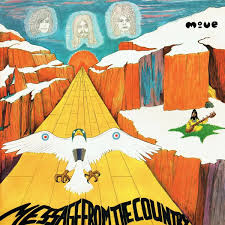
Wood and Lynne were roughly splitting the songwriting and vocals at this point, though Bevan has the credit for “Don’t Mess Me Up” and the lead vocal on “Ben Crawley Street Company.” While Wood had handled almost all of the composing in the Move’s early years, he and Lynne were a good combo. They excel best on Message from the Country on the songs that blend hard progressive rock and almost whimsical pastoral folk in ways that only the late-period Move could. Wood’s “It Wasn’t My Idea to Dance” is an almost hit single-worthy entry in that vein, and the Lynne-penned title track isn’t far behind. Lynne’s melancholy, folky “No Time” is another highlight, and another cut on which the band’s idiosyncratic mix of non-blues slide guitar and recorder couldn’t be mistaken for the work of any other band.
Wood never lost his affection for straight-out rock and roll, albeit with a harder rock edge than vintage ‘50s oldies, as “Ella James” proves. Elsewhere the Move’s restless shifts are less memorable, and sometimes apparently less than serious, as on Bevan’s ‘50s rock’n’roll pastiche “Don’t Mess Me Up,” and most particularly on the apparent Johnny Cash satire “Ben Crawley Steel Company,” sung with a straight country drawl (and pseudo-American accent) by Bevan. The LP-closing “My Marge” is more vaudeville than rock and roll, and not a highlight; was any fine rock act’s ventures into vaudeville among their highlights, bar maybe some of the Kinks’ music hall-like outings?
Message from the Country has usually not been extremely hard to find, and indeed the track list on this 2025 reissue is identical to the one on the 2005 Harvest CD reissue of Message from the Country. It’s also nearly identical content-wise to the deceptively titled 1994 CD comp Great Move! The Best of the Move. Far from being a career retrospective, that 1994 disc merely repackaged Message from the Country with the 1971 single “Tonight,” both sides of the 1971 single “Chinatown”/ “Down on the Bay,” and the 1972 farewell single “California Man”/ “Do Ya” (which also included Message from the Country’s “Ella James,” to be technical).
This 2025 edition has all of those non-LP cuts as bonus tracks, plus alternate versions of “Don’t Mess Me Up,” “The Words of Aaron,” “Do Ya,” and “My Marge,” so it’s puffed up just a bit. The bonus tracks from non-LP singles aren’t mere afterthoughts; in fact, a couple are among the best recordings from the Move’s career. Wood’s acoustic-driven, ultra-catchy “Tonight” was a UK hit and should have been a US one, though the Move never did manage one Stateside. Their closest shot, Lynne’s “Do Ya,” is fine riff-driven harmonized hard rock, though it was inexplicably a B-side (to Wood’s less melodic hard rocker “California Man”) in the UK, and is far more known via ELO’s 1976 hit remake.
The liner notes in the twenty-page booklet are different from the ones in the 2005 edition, and include a few pictures/labels/advertising from the period. Yet otherwise this is no different from the 2005 reissue, which also added all of these non-LP tracks and unremarkably different alternate versions. But hey, it’s been twenty years, and if you missed out before, easy availability has now been restored. (This review previously appeared in Ugly Things.)
13. The Jimi Hendrix Experience, Bold As Love: The Axis: Bold As Love Sessions (Experience Hendrix/Legacy). Of the three Jimi Hendrix Experience albums, the middle one, Axis: Bold As Love, is the least impressive, mostly lacking the killer original songs of the Are You Experienced debut and about half the 1968 double LP Electric Ladyland. That’s quite relative, of course; Axis: Bold As Love was good and substantially different from the albums that bookended it, being perhaps more low-key and soul-oriented. This deluxe edition presents the original stereo mix, the original mono mix, and two CDs of outtakes/demos/alternatives/live/radio recordings from the Axis era, as well as a Blu-ray with the stereo/mono/Atmos mixes.
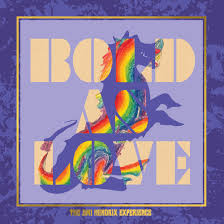
The two discs of extras, more than half previously unreleased, are what’s of most interest, though in common with many recent superdeluxe editions, it’s more of historical interest than something to compete with the familiar versions. There are just a few songs that didn’t make the LP, including an earlier version of “Mr. Bad Luck”—a solid enough blues-rocker—than the October 1968 one issued on 1971’s Rainbow Bridge. A few untitled instrumentals are more notable for his guitar work than the melody or ideas for fully realized songs, Hendrix making use of the Echoplex on the October 4, 1967 solo recording simply titled “Untitled Guitar Experiment.” “Untitled Instrumental #2” actually puts the emphasis on hastily strummed rhythmic chords, its tense riffs occasionally punctuated by particularly emphatic chord-riffs.
There are also mono mixes of both songs from his 1967 UK post-debut LP single “Burning of the Midnight Lamp”/“The Stars That Play with Laughing Sam’s Dice,” as well as outtake versions of both tunes. “Burning of the Midnight Lamp” would find a place on Electric Ladyland with a different mix, but for many years the rather slapdash and informal “The Stars That Play with Laughing Sam’s Dice” was difficult to find, especially in the US. Whether heard in the mono 45 version or the others, there are few other songs by major artists of the time that were such B-side filler throwaways. Even the Beatles’ “You Know My Name” had a lot more effort and craft put into the track.
The different versions of songs from the LP are not so much strikingly different as notable for their more basic nature, before more refined performances were laid down and additional touches, sometimes including overdubs, added. Sometimes the change is more audible than others. “Up from the Skies” actually benefits from the absence of the gimmicky varispeed vocals on the “EXP” track that preceded it on the LP, and take 2, like some other outtakes here, lacks a vocal, allowing you to focus on the instrumentation. The demos of “Ain’t No Telling” and “Little Miss Lover,” recorded at Regent Sound prior to the sessions at Olympic Studios for the proper album, might be as close as we get to live versions, considering they weren’t incorporated into his usual concert repertoire.
More than half of disc four is devoted to live and radio broadcasts from August-November 1967 in Britain, Sweden, and Holland, all of which have appeared on previous archival sets except for the Dutch TV performances of “Purple Haze” and “Foxy Lady” from November 10, 1967. Like many artists Hendrix didn’t mix up his set too much with surprises, but you do get a “Sgt. Pepper” cover from his September 5, 1967 Stockholm show, as well as a live version of “Burning of the Midnight Lamp” from the same concert. Generally the other selections, including versions of familiar songs like “Fire” and “Hey Joe,” aren’t the best live recordings of those tunes available from either performance or fidelity standpoints, though they’re okay. The Dutch TV “Purple Haze” and “Foxey Lady” are pretty fiery, though, with plenty of wild distortion opening “Purple Haze.”
Like many a deluxe expansion of a classic album, this is more for the intense fan than the general listener, but the abundant extras do at the least make for good and sometimes attention-grabbing listening. The booklet features extensive liner notes, vintage photos, and track-by-track annotation for the two CDs of extras by Hendrix authority John McDermott.
14. Ruperts People, Dream in My Mind Anthology 1967-1999 (Strawberry). It’s tempting to call the story of Ruperts People more interesting than their music, so strange was it in a time with no shortage of bizarre band tales. But they did record some cool and worthwhile material in their short career, all of it on this compilation of rare singles and unreleased tracks. Although, as it transpires, they weren’t even on the most famous record credited to them – just one of the peculiar indignities they suffered.
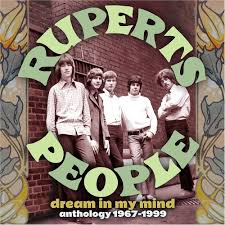
Certainly the song for which they’re most remembered is “Reflections of Charles Brown,” a stately slice of classical-influenced British psychedelia that’s been oft-reissued after its failure to sell in 1967. (That is, incidentally, the correct title, though the character’s clearly referred to as “Charlie Brown” in the lyrics.) This was, alas, one of the songs on which the actual band Ruperts People didn’t appear, as it was actually recorded by fine mod-psych outfit Fleur De Lys (sometimes billed as Les Fleur De Lys), who have an even more twisted history of their own.
The weird journey of Ruperts People is extensively detailed in the liner notes. But basically they started as the Sweet Feeling, whose rare 1967 single (included here), “All So Long Ago” (which sounds much like the “Dead End Street”-era Kinks), was backed by the interesting melancholy early psychedelic effort “Charles Brown,” suffused with backward effects and phasing. But “Charles Brown” is not the same song as “Reflections of Charles Brown,” as Sweet Feeling singer and songwriter Rod Lynton was induced to rearrange the song into “Reflections of Charles Brown” – on which he didn’t sing when Fleur De Lys recorded it, though he got a co-writing credit. Got all that?
Fleur De Lys also bagged “Reflections of Charles Brown”’s B-side, the fine soul-rocker “Hold On,” and both sides of that 45 are on this CD. They’re here because this single – “hold on,” the story’s getting even more complicated – was credited not to Fleur De Lys, but to Ruperts People. When Fleur De Lys declined to promote the 45, Sweet Feeling changed their name to Ruperts People, getting Dai Jenkins of the Iveys into the lineup on guitar. Two Ruperts People singles with ex-Sweet Feeling members followed in 1967 and 1968, both included here, and they’re nice British pop-psych-mod cuts, all written or co-written by Lynton.
These didn’t establish a strong identity for the outfit, however, who sometimes sounded not far from the psych-era Small Faces. Ruperts People didn’t last much beyond a troubled residency in Beirut, where they met student Miles Copeland. Copeland (later to manage the Police and head IRS Records) managed them until he tried to install his brother (and future Police drummer) Stewart in the band, upon which Ruperts People split. The full, yet more involved story’s told in the liner notes.
The disc is filled out with the generic blues-rocker (“Love/Opus 193”) used on the German B-side of “Reflections of Charles Brown” and some lower-fi (but not too lo-fi) unreleased tracks from acetates and live recordings. The highlights of these are the instrumental “Flying High,” which sounds like a promising backing track for what could have been a neat classical keyboard-inflected psych tune, and “Reflecting,” which at times sounds not unlike first-album Soft Machine. A few less interesting live numbers from a 1999 reunion gig fill out this odd curio, worth your time if you’re heavily into early British psychedelia, despite its uneven quality and the inclusion of the “actually Fleur De Lys under a different name” single. (This review previously appeared in Ugly Things.)
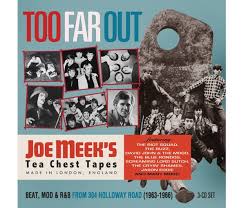
15. Various Artists, Too Far Out: Beat, Mod & R&B (1963-1966) (Cherry Red). This isn’t an overall survey of British music in those styles from this period, which would take up at least a half dozen CDs even if you were being pretty selective. As some other lettering on the cover makes clear, it’s one of the ongoing installments in Cherry Red’s series of compilations devoted to “Joe Meek’s Tea Chest Tapes.” So everything here was produced by Meek, the 88 tracks divided roughly equally between songs that were released on singles and “originally unreleased maters and sessions,” all dating from 1963-66.
Some party lines have it that Meek, indisputably the most imaginative British rock producer of the early 1960s, couldn’t progress with the times once the Beat Boom started to overrun the British rock scene. While he didn’t have many big hits during the years spanned by this anthology, actually he did record quite a few acts in the last few years of his life who fit very much in the “beat, mod & R&B” genres. What’s more, he produced some of the best “freakbeat” sides of all time, though that term wasn’t in use in the mid-1960s.
Take the best dozen or so tracks from the 45s collected here, and you’d have a killer LP, everything bearing Meek’s trademark ultra-compressed sonics and knack for odd, oft-captivating studio effects. The cuts by Screaming Lord Sutch, Heinz, the Honeycombs, and the Outlaws all qualify on that score, but so do highlights by no-hitters like the Syndicats, the Buzz, David John & the Mood, the Riot Squad, Tony Dangerfield, and Jason Eddie. Indeed, the Syndicats’ demented “Crawdaddy Simone” isn’t just one of the best freakbeat records of all time—it’s one of the best non-hit singles of the mid-‘60s bar none. The Buzz’s feral “You’re Holding Me Down” is almost as good and almost as demented, with one of the nastiest lead vocals of the entire British Invasion.
If you’re curious enough to consider buying a three-CD box with several dozen unissued tracks, however, you probably already have most or all of these. What of the rest, three of which are so unknown they’re actually billed to “Unknown Group #1,” “Unknown Group #2,” and “Unknown Group #3”? It’s a frustrating proposition. On the one hand, Meek fans and scholars will very much appreciate hearing what else he was up to besides those killer tracks that have shown up on other (sometimes quite a few other) compilations. On the other, there’s no denying that the lesser known singles, and certainly the unreleased stuff, on the whole certainly aren’t nearly as good as the cream of this crop.
This shouldn’t be too much of a surprise. Every producer or label tends to release the best of their product, and often leave average items in the vault, or not even release anything by some acts they tape or audition. Some of the obscure or previously unheard material is pretty generic, and some of the covers opt for overdone tunes—after you’ve heard Bo Diddley, the Pretty Things, and even David John’s versions, is it so gripping to hear the Classics’ take on “Pretty Thing,” which is about as ordinary as their name? There’s also the sense Meek didn’t put as much of his idiosyncratic studio stamp, and certainly not as much as his nearly-on-the-edge mania, into the productions that didn’t see the light of day back then.
This doesn’t mean that most of the non-killer singles, and many of the vault finds, don’t make for pleasing listening if you’re such a fiend for these styles that you enjoy decent generic British Invasion music, as I do. Nothing really sticks out as compelling lost gems, but among the unreleased efforts that come off better than others are Flip & the Dateliners’ “Bye Bye Baby Bunting,” with its Millie Small-type vocal, though it’s not ska. Unknown Group #3 actually do a fair Georgie Fame & the Blue Fames imitation on their rendition of Charlie Rich’s “That’s My Way.”
It’s also interesting to hear a couple songs that were done by Meek’s better known clients attempted by others. Tony Dangerfield (heard on disc one with his long-since-reissued “She’s Too Way Out,” albeit via an alternate vocal take) tries “Big Fat Spider,” one of Heinz’s better records; the Buzz have a go at “Should a Man Cry,” though Meek opted to put out the Honeycombs’ haunting treatment. There’s also a previously unissued 1964 track by the Sorrows, one of the best British Invasion groups that didn’t make it real big, but don’t get too excited. Their cover of Sonny Boy Williamson’s “Don’t Start Me Talking,” predating everything they’d record slightly later without Meek, is pretty routine. Since the liners refer to (plural) recordings they made with Meek in ’64, it makes you wonder what other Sorrows tapes might be in Meek’s tea chest.
On the train-spotting side of things, there’s a bit of difference in some of the more oft-heard tracks. For what it’s worth, some songs are heard at their original speed, not the altered versions that appeared on the original singles. That’s not a big deal, I’d think, to most listeners, and the Outlaws’ “Shake with Me” (with its astonishing Ritchie Blackmore guitar solo) sounds better in the familiar sped-up 45 incarnation used on other reissues. A few others have alternate vocals, and the Riot Squad’s “I Take It That We’re Through” is an alternate early version that isn’t as good as the one that came out on a single.
The set as a whole would be a better listen had more prime items by the likes of Heinz, the Honeycombs, and Sutch been included, but those acts have been represented by comps of their own. The twenty-page liner notes provide quite a bit of detail on all of the acts and tracks, with lots of photos and sleeve/label/ad/tape box reproductions. (This review previously appeared in Ugly Things.)
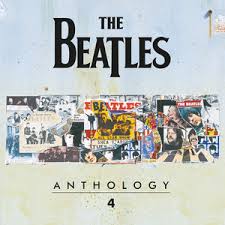
16. The Beatles, Anthology 4 (Apple). Considering how good the Beatles are, and that they’re my favorite musical act, its low ranking here is an indication of how far down the barrel Anthology 4 scrapes for some previously unreleased material. “Some” is an important qualifier, since just 13 of the 37 tracks on this double CD were previously unreleased (the rest have come out on various other archival compilations over the last thirty years). More crucially, those thirteen items are all alternate takes of songs released in the 1960s, none drastically different, and some only mildly different, or essentially backing tracks.
Such takes have been issued all along since Anthology 1, of course. But the main value of the Anthology 4 variations was to illustrate how much was added by the Beatles to the initial studio passes to significantly improve the final result. That’s of considerable interest to historically minded listeners, but not among the most enjoyable Beatles rarities, when the main things that come to mind are, for example, the missing tone pedal guitar in “I Need You”; the missing guitar solo and piano notes in “Every Little Thing”; or the absent George Martin keyboard part in the instrumental break of “In My Life.” Because these are the Beatles, even hearing subpar works-in-progress can be enjoyable, like their loose run through “Tell Me Why” or a largely vocal-less version of “Nowhere Man” that lets you hear the Byrds-like guitar lines better. The limited joy diminishes with cuts like a “Hey Bulldog” backing track missing the hurly-burly guitar solo.
I’m enough of a Beatles obsessive to still welcome these variations, even though they could have fit on a single CD for considerable less expense. Although it’s not great value for someone like me who already has two-thirds of this on other archival releases, the addition of those previously available tracks does make this more listenable when you’re playing both discs all the way through. However, Anthology 4 indicates there really might not be much exciting left in the vault, and perhaps not enough to fill out superdeluxe editions of pre-Revolver albums. It also overlooks some more interesting unissued material that could have been considered, like the (if rather lo-fi) six BBC radio tracks from sessions with Pete Best in the first half of 1962, or the “What You’re Doing” with a key change and different guitar solo in the instrumental break.
17. Patsy Cline, Imagine That: The Lost Recordings (1954-1963) (Elemental Music). This double CD assembles previously unreleased material from a wide variety of sources: live concerts, radio shows, TV shows, and studio outtakes. A wealth of posthumously issued live and radio Cline recordings have appeared over the last few decades, and while this is a valuable supplement to those, on the whole it’s not as consistent or good as the best such collections, like Live at the Opry and Live Vol. 2. But the fidelity’s excellent to acceptable, and there are fifteen songs that haven’t appeared in other versions, though none of those are on the level of her best material. There are also two versions apiece of her big hits “Walkin’ After Midnight” and “I Fall to Pieces.”
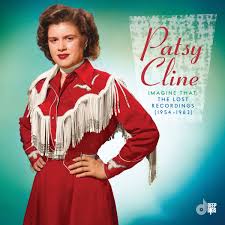
This is sequenced roughly chronologically for the most part, with earlier tapes on the first CD and later ones on the second. All artists evolve over their first (and in Cline’s case, only) decade, but there’s a bigger difference than usual between the earlier and later material. On disc one, mostly dating from the 1950s, she’s an above-average honky-tonk singer, but not nearly as distinctive as she is on the more recent material from the early 1960s on disc two. Her range widens, especially at the deep end, and she arrives at her knack for country-pop ballads that set her apart from most country stars of the period and helped her cross over to a pop audience. That’s evident on these renditions of the hits “I Fall to Pieces,” “Crazy,” and especially the set’s highlight, “She’s Got You.” But it’s also on lesser known tunes like “I Love You So Much It Hurts,” and she could still handle uptempo numbers like “When I Get Thru With You.” The spiritual and Christmas cuts aren’t so good, and unfortunately there aren’t versions of some of the stronger songs she had success with near the end of her life, particularly “Strange.”
18. Pete Ham, Acoustic (Y&T Music). Considering Badfinger’s success wasn’t enormous, there are more compilations of archival recordings by Pete Ham, their most prominent singer-songwriter, than you’d expect. There are at least five that I know of, including this most recent one, which collects acoustic recordings spanning at least 1968-74 (some of the thirty tracks are undated). It’s true that the appeal of this release must be limited to serious Badfinger fans. The sound is okay, but basic, with the lyrics sometimes being hard to make out; the performances, while good and heartfelt, were obviously not intended for release, likely serving more as reference tapes to develop potential commercially available songs; those performances are sometimes fragments of songs, or informal sketches, some instrumental. The annotation is minimal, though not through any apparent fault of the compilers, as it seems likely they present whatever information is available for each track. It’s a little like coming across a bootleg that happens to get professional packaging and release.
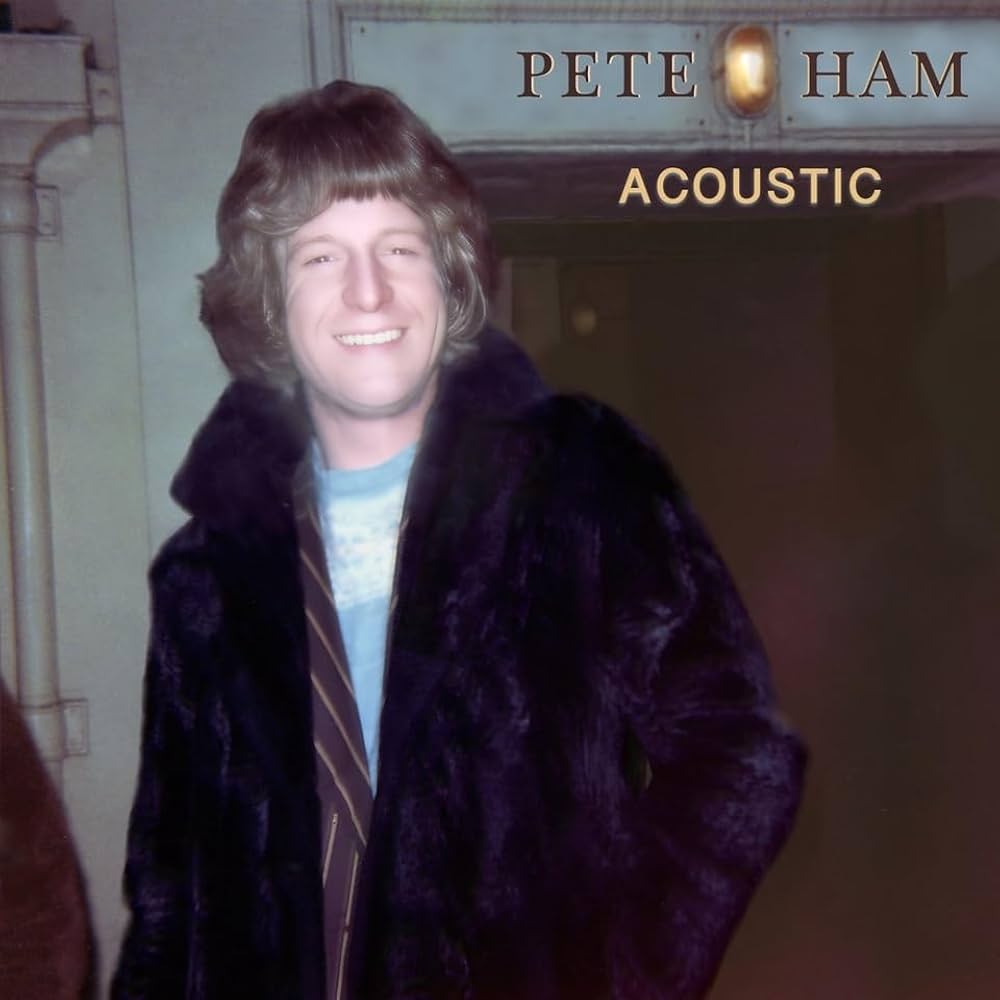
My search for what interests me as a collector, and what I include on this list, isn’t unduly bothered by such things. Keeping your expectations at the appropriate level, these relics have a lot of charm, with Ham’s characteristic gift for uplifting pop-rock melody. Yes, few of the songs are on the level of the best Badfinger songs, a notable exception being the demo for “We’re for the Dark,” which was one of that group’s best (if not one of their most well known) songs, concluding their second album. “Hand in Hand,” a different version of which appears on the most widely circulated commercial compilation of Ham recordings (7 Park Avenue), is also in that league. “Can You See,” as aptly observed in the notes, is quite similar to some Pete Townshend songs in its acoustic drive. The melancholic instrumental “Pete’s Postcard” fluidly blends several overdubbed guitar parts.
But with the exception of some obvious throwaways, most of this is like listening to a talented songwriter, decent guitar, and okay guitarist work out some very pleasant tunes, though none of them stick with you as much as the aforementioned ones. It’s hard to imagine much more Ham or Badfinger-related material has yet to be unearthed, though the Y&T label is certainly on the case, having issued five volumes of recordings by the band from which Badfinger evolved, the Iveys (volume five is reviewed further down this list). In the meantime, it’s likely most committed Badfinger fans will enjoy this release without reservations.
19. The Doors, Live in Copenhagen (Elektra/Rhino/Doors/Bright Midnight). This would have ranked higher if there wasn’t much or any other live Doors in their catalog. Of course there’s a great deal of live Doors (and studio Doors, as seen in another Doors release on this list) the band didn’t release during their lifetime in their discography. This September 17, 1968 concert isn’t among the best of them, both because the sound is imperfect, though not too flawed, and because other releases have other live performances from this era (such as the ones featured on Live at Konserthuset, Stockholm, from just three days later) that contain a bigger repertoire in better sound. Still, though Jim Morrison’s condition during this period was legendarily erratic, he and the group are in good form on this document, though it offers little in the way of surprises.
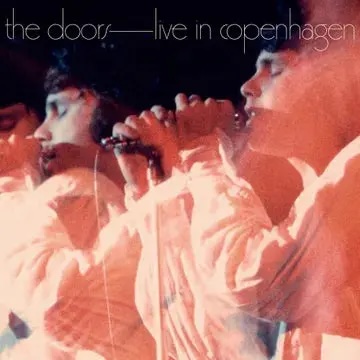
There aren’t many such surprises on a set that’s largely devoted to oft-performed numbers (“When the Music’s Over,” “Back Door Man,” “Five to One,” “Light My Fire”) and somewhat less overdone ones that are nonetheless represented by other versions in circulation (“Hello, I Love You,” “Break on Through,” “The Unknown Soldier”). Note, however, that this “Break on Through,” unlike the Absolutely Live track, mostly sticks to the more concise arrangement from their debut LP and doesn’t interject the “high” in “she gets high” that the Doors had to take out of the track on that album. Also this has a full version of “Alabama Song,” which was usually part of a medley with “Back Door Man,” and (as previously heard on other recordings from their 1968 European tour) an abbreviated “The Wasp (Texas Radio & the Big Beat”), predating the fuller treatment featured on L.A. Woman. In fact, although this contains a track titled “The Wasp (Texas Radio & the Big Beat,” it’s actually just a spoken brief poem with minimal musical backing, which is a problem when Morrison’s vocal is rather faint throughout this recording, and especially faint on this bit. It’s not a problem, but Robby Krieger can’t quite emulate the glissando near the end of the studio hit recording of “Hello, I Love You,” though he does his best with a distorted guitar swoop/slide.
As with many, and maybe the substantial majority, of acts then and now, one wishes the Doors had varied their set more, though they weren’t thinking of the repetition of songs on archival releases back in 1968. Could someone have suggested to them to throw in something like “Take It As It Comes” or “Yes, The River Knows” once in a while, to name two songs not represented by any live recordings in circulation?
20. The Alan Price Set, BBC Sessions 1966-68 (Rhythm and Blues). This two-CD, 52-song compilation (dotted with about a dozen brief interviews) — actually covering 1966 to 1970, despite the title — is a valuable supplement to Price’s 1960s studio recordings. It features radio renditions of many tracks from his studio releases of the period, including the UK hits “I Put a Spell on You,” “Simon Smith & the Amazing Dancing Bear,” “Hi-Lili, Hi-Lo,” “The House That Jack Built,” and “Don’t Stop the Carnival” (he never had hits in the US, unless you want to count “I Put a Spell on You” getting to #80). The sound is good and clear, and of most note, there are a number of songs he didn’t put on his albums and singles of the period. Those are all covers, largely though not always of the R&B/soul kind, including “Baby Work Out,” “Shake,” “Barefootin’, “I Take What I Want,” “The Walk,” “Rip It Up” (two versions),” and “I Was Made to Love Her.” Most surprisingly, he also takes on “Don’t Let Me Be Misunderstood,” which had been a big hit for the band he’s primarily famous for being a part of for a while (before he led his own on record), the Animals.
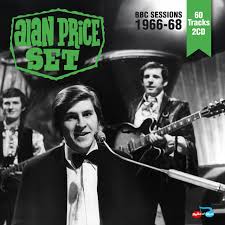
However, he was more acceptably competent at this kind of thing than the two acts with which he was most prominently associated, the Animals and (later) Georgie Fame. “I Put a Spell on You,” done well in an arrangement close to the hit single, is by far the best thing here. Price did also get into more music hall-influenced material, and was among the first notable artists to cover Randy Newman compositions with “Simon Smith & the Amazing Dancing Bear,” “Living Without You,” “Love Story,” and “My Old Kentucky Home.” His keyboard playing is excellent, and he (and Fame) were among the few British Invasion artists to utilize a horn section, but his vocals and occasional own compositions (which did include “The House That Jack Built”) were more okay than innovative or exciting.
This is almost as good a summary of his early post-Animals years as his studio recordings, which were issued in full on the two-CD anthology The House That Jack Built: The Complete 60s Sessions (which includes ten BBC cuts that are also on this compilation). But for all its merits, the packing on this collection has some notable flaws. It does list dates for each track and personnel, but as noted this spans 1966 to 1970, not the 1966-68 years given in the title. The liner notes are perfunctory, and more seriously, the writing credits aren’t wholly accurate, attributing “1941” to Price instead of Harry Nilsson. Dates are only given for 27 of the 29 tracks on the second CD, and it’s obvious some of them are misattributed. Too, the volume level dips notably for “Barefootin,’” despite the generally fine audio quality.
21. The Iveys, Anthology 5: Miniskirts and Rainbows (Y&T Music). The Iveys were the band from which Badfinger evolved, and even managed to put out an LP (albeit not issued in the UK or US) and a few other tracks at the end of the 1960s before they were renamed. These are demos from between 1966 and 1969, and only a couple of the songs (“Angelique” and “Yesterday Ain’t Coming Back”) would appear on the Iveys’ album, with another, “Blodwyn,” getting redone for Badfinger’s No Dice LP in 1970. All of these were recorded before Joey Molland joined; Ron Griffiths, who wouldn’t make it into Badfinger’s hitmaking phase, is on these, and “Spider Woman” has another semi-original Badfinger member, guitarist-singer Dave “Dai” Jenkins.
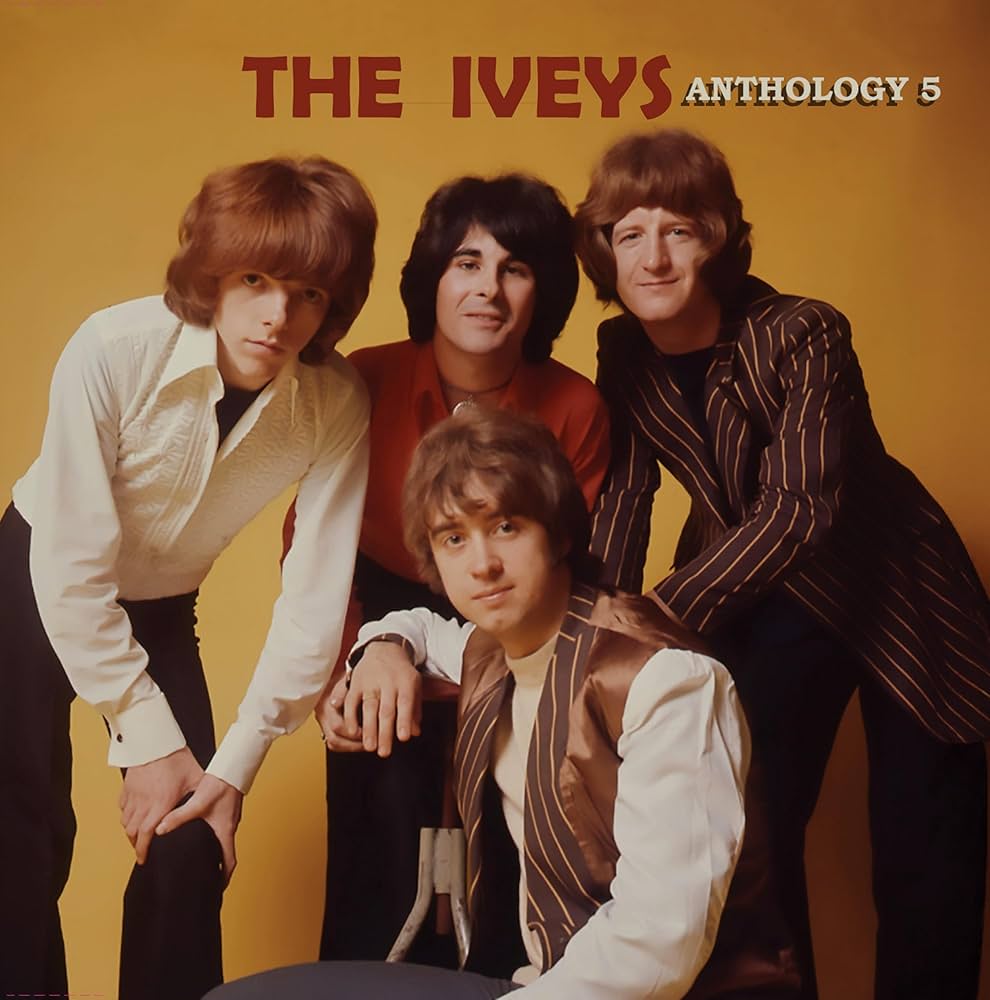
Like Badfinger, these songs and compositions have a strong Beatles influence, albeit from the Beatles’ poppiest side, with some general aura from the late-‘60s British psych-pop scene. Overall it’s the kind of material that labels would consider cultivating as part of a “development deal,” if that term was in use those days. There’s promise, but the songs aren’t too strong, if, as the cliché goes, nice enough for this sort of thing. “Angelique” and “Yesterday Ain’t Coming Back” are the best of them, and a little marred by the group singing what are intended to be horn parts. Should you be a big Badfinger fan, however, they’re certainly interesting to hear as roots of what became a better and more muscular group, the recruitment of Molland probably being a big part of that transition.
As an aside, few groups other than Badfinger come to mind as having so much archival material in a relatively short space of time. Badfinger were pretty productive during their lifetime, with half a dozen albums if you count the one billed to the Iveys. Yet there are five collections of Pete Ham demos available; one of their most prominent other songwriter, Tom Evans, which I haven’t heard, as it’s not easy to find now; and five volumes for the Iveys. Plenty of Badfinger/Iveys BBC/live material is also in official and unofficial circulation. They certainly had a surplus of original material, more by Ham than anyone else, though others in the group wrote (including Griffiths, who has a few compositions here). Not a whole lot of that surplus stood out as striking, however, and was more a testament to their prolific activity as they searched for a style and the best songs to work on, rather than undiscovered treasure on par with Badfinger’s best tracks.
22. Doc Pomus, You Can’t Hip a Square: The Doc Pomus Songwriting Demos (Omnivore). Pomus was one of the greatest songwriters of the era when the Brill Building was at its peak from the late 1950s through the mid-1960s, most often (though not always) composing with Mort Shuman. Many demos, or at least informal recordings, were taped of songs he wrote or co-wrote, some (but by no means all) of which he sang on. Many of them, most of them previously unreleased, are on this six-CD box. There are demo or demo-ish versions of some of the big hits with which he was associated, like “A Teenager in Love” (also heard in its earlier, inferior, more innocuous incarnation, “It’s Great to Be Young and in Love”), “This Magic Moment,” “Hushabye,” and a few Elvis Presley hits. The great bulk of these, however, aren’t too well known, and sometimes weren’t covered by anyone on official releases.
This has undeniably great historical value. But it’s fairly low on this list because if you’re not up for rather scholarly listening (though I am), the entertainment value isn’t nearly as high as hearing the released versions of the best songs on which Pomus was involved as a writer. (The Ace compilation The Pomus & Shuman Story: Double Trouble 1956-1967 collects many, though not all, of those.) This is true of many, perhaps most, demos from major songwriters: the best stuff was recorded in much better, more elaborate versions for official discs, and much of the rest wasn’t nearly as good. That could be a consequence of the pressure to grind out so much material as part of the Brill Building, but many of the songs have a formulaic early-‘60s rock’n’roll feel, and a good number of them don’t have such great fidelity. Mort Shuman (who wasn’t a bad singer), not Doc, sings the majority of these, with quite a few other singers acting as demo vocalists on others, some well known or somewhat known (Ellie Greenwich, Toni Wine, Peter Anders, Kenny Rankin); some very obscure; and some literally unknown, as they can’t be identified.
The best tracks, by a considerable margin, are the ones on the disc of demos done for Elvis Presley. Those were issued a few months before this box for a double-LP vinyl Record Store Day release, and discussed in more detail in the separate review in these listings for that compilation. Generally, however, it seems like more effort and energy was put into these than the many other songs on this box, both in the songwriting—perhaps in realization of how higher the stakes and potential rewards were for a Presley disc—and the actual recordings, most of them sung with fairly committed Shuman vocals. These include demos for the hits “A Mess of Blues,” “She’s Not You,” “Viva Las Vegas,” “Suspicion” (made into an Elvis-like hit by Terry Stafford), and some of Presley’s better soundtrack tunes and album filler. One such tune, “Gonna Get Back Home Somehow,” is actually the best such thing on this disc, and some other numbers on the Elvis CD weren’t even recorded by Presley.
On the other CDs, many of the songs are unfortunately forgettable, few standing out as either potential hits or tunes that stick with you now, when their purpose is to educate and possibly entertain, not to get someone to record it and possibly sell copies sixty to sixty-five years ago. A sedate girl group version (vocalists unknown) of “What Am I To Do?” is interesting as Manfred Mann did a far more dynamic cover in the mid-1960s; the same goes for “Leave It To Me,” done better by the fairly obscure Liverpool group Ian & the Zodiacs. A few items venture outside of the R&B/pop-base more typical of Pomus’s efforts, like the intriguingly winding bittersweet melody of “Half a Love Is Better Than None At All,” an acoustic piece sung and co-written by Bobby Andriani. But most of this isn’t nearly on the same level as release-quality demos that have found official release by Carole King and Jackie DeShannon, to name the most prominent examples among top songwriters from a similar era.
Doc Pomus had a recording career in the early 1950s as one of the first—if not the very first—white R&B/blues singers before concentrating on songwriting. Disc six of this box features his lead vocals on a batch of tunes he wrote or co-wrote, just one of which is well known (“Lonely Avenue,” first done by Ray Charles), and is bluesier than the rest of the set. Disc six also has a few tracks featuring Pomus as the artist, dating from the late 1940s through the mid-1950s, that were previously issued. The box also has extensive 48-page liner notes.
23. Sly & the Family Stone, The First Family: Live at Winchester Cathedral 1967 (High Moon). As significant as Sly & the Family Stone were, this recording of a live March 26, 1967 show in Redwood City (not far south of San Francisco) gets more into historically valuable territory than musical brilliance. That’s for a couple reasons. There isn’t much original material here, and even the one original composition, “I Ain’t Got Nobody,” borrows from Willie Bobo’s “Spanish Grease” (as later adapted into Santana’s “No One to Depend On”). The sound isn’t sparkling, and the vocals in particular sometimes not too clear, though this is fully noted and explained in the liner notes. There are many seeds of the band’s innovative interplay and balance of improvisation and tightness. But at this early point in their evolution, they sound more like a creative and eccentric cover band than the one that would blaze a soul-rock-psychedelic trail with their famous hit records, sometimes mutating and twisting the arrangements so they sound more like Sly songs than covers.
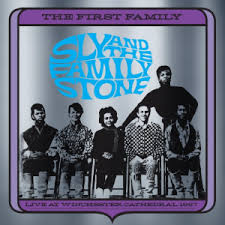
Of course that doesn’t mean this isn’t worth hearing, certainly for historical reasons, and for the most part for entertaining listening, certainly for serious Sly fans. While the songs include some big soul hits—Otis Redding’s “I Can’t Turn You Loose” and “Try a Little Tenderness,” Joe Tex’s “Show Me,” the Four Tops’ “Baby I Need Your Loving,” and Dyke & the Blazers’ “Funky Broadway”—there are also less familiar songs, like Lou Courtney’s “Skate Now” and Junior Walker’s “Pucker Up Buttercup.” Rose Stone had yet to join when this was taped, but otherwise this has much of the template for the group’s sound getting set. Alec Palao’s liners are exceptionally detailed, to the point that they might be more interesting than the music, including quotes from all of the members heard on this recording.
24. The Doors, Strange Days 1967: A Work in Progress (Rhino). The Doors are one of my favorite groups. I’m enough of a completist that I have most of their many archival releases, and have reviewed numerous of their annual ones, which appear as regularly as if Jim Morrison were still alive. Those releases don’t get much mainstream attention, yet they’ve usually ranked fairly high on my best-of lists. Why, then, is this Record Store Day vinyl LP collection of “rough mixes from the album’s early 1967 sessions discovered after 58 years” so low? Especially since Strange Days, though not my favorite Doors album (their debut is mine), is very good, mostly devoted to classic songs?
Although, as the cover sticker says, these tracks are “without the final overdubs heard on the original release,” really the differences are not that great, and are on the audiofile level rather than one with sit-up-and-take-notice variations to strike or even get detected by many listeners. To use a disagreeable cliché that’s gaining traction in the reviewing world, you have to squint your ears to figure what’s missing and different. Sure, sometimes instruments like the organ are louder than what you’re used to, and the sound quality’s very good. But not only do these sound close to the final versions—a few songs aren’t here at all, and those aren’t trivial omissions. There’s no “People Are Strange” or “Moonlight Drive,” and while “My Eyes Have Seen You” and “Unhappy Girl” aren’t as major MIAs, their absence hurts too.
There are a couple mini-mysteries this collection sparks. One of the songs, “We Could Be So Good Together,” did not appear on Strange Days, instead surfacing on their next album, 1968’s Waiting for the Sun. I do not recall ever reading that work on this song, which here sounds very similar to the Waiting for the Sun version, began during the Strange Days sessions. Although this isn’t discussed in engineer Bruce Botnick’s brief liner notes, this LP’s credits imply this was indeed a leftover/outtake from Strange Days, as they note that “all tracks were recorded from February to May 1967 and are early versions of album tracks.” Or were they?
Also not discussed in the notes: the last part of this rough mix of “When the Music’s Over” drops noticeably in key from the previous part of the track. Why is that? Is this a combination of two different versions/mixes, or is there some other reason?
** — denotes releases in which I was professionally involved as a writer of liner notes and/or compiler.
I wasn’t able to hear the following 2024 releases in 2024 itself. But as usual, I wanted to make room for albums of note from the previous year that didn’t make my 2024 list for that reason, but are worthy of attention:
1.Davy Graham, He Moved Through the Fair: The Complete 1960s Recordings (Cherry Tree). Davy Graham never quite went into straight rock music. But the British guitarist’s eclecticism, use of backup musicians, and combination of folk, blues, jazz, and world music meant both that his influence was felt in the rock world, and that his distinctive hybrid is likely to be enjoyed by many adventurous ‘60s rock fans. Virtually all of his ‘60s output is on this box, built around the seven LPs he released between 1963 and 1970, along with quite a bit of extra material.
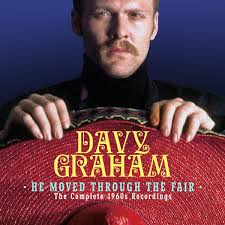
Thrilling at his best, and often crafting an exciting, unnervingly haunting ambience, Graham’s extraordinary instrumental skill didn’t prevent his discography from being quite uneven, both from album to album and within his albums. His 1963 debut The Guitar Player was more accomplished folk-jazz-blues than risky blends of several styles, though even then he separated himself from most of the British pack by using drums (the great session player Bobby Graham) and, on one track, additional guitar by Alexis Korner. Of most interest from this period are his recordings of the instrumental “Anji,” famously popularized by Simon & Garfunkel, and heard here among the three tracks from his EP ¾ AD, as well as in a live 1961 performance.
Graham really established himself as a major force on 1965’s Folk, Blues & Beyond, with fuller backup and rhythmic thrust from drums and double bass. These push the tracks toward rock at times, much like Duffy Power’s rather folk-blues-jazzy mid-‘60s outings did. Graham wasn’t nearly the singer Power was, however, though he was, as the cliché goes, serviceable. “Leavin’ Blues” in particular verges on blues-rock, and on “Maajun,” he was among the first musicians of the era to effectively combine middle eastern/African sounds with Western forms. Although most of the material was drawn from traditional folk and blues, he also ventured into some jazz (“Moanin’,” Charles Mingus’s “Better Git It in Your Soul”) and, with Dylan’s “Don’t Think Twice, It’s Alright,” efforts by contemporary writers.
1966’s lesser known Midnight Man broadened his reach with his hypnotic cover of Lalo Schifrin’s “The Fakir” and his best original composition, the captivating jazz-bluesy “Hummingbird.” He also offered his first Beatles cover with “I’m Looking Through You,” and although he’d usually stick to decent covers of Lennon-McCartney and Paul Simon when he interpreted rock tunes, he also offered respectable versions of “Walkin’ the Dog,” “Money Honey,” and “Neighbour, Neighbour.” “No Preaching Blues” is another of his best originals, while he continued to use spare but energetic backup with more effectiveness than other acoustic guitarists.
Graham moved about as close to blues-rock, or accessibility to the rock audience, as he ever did with 1968’s Large As Life and Twice As Natural. Bassist Danny Thompson (Pentangle), flute player Harold McNair (who worked with Donovan), and Bluesbreakers/Graham Bond veterans Jon Hiseman (drums) and Dick Heckstall-Smith (sax) all brought some rock credentials. At times this sounds a bit like a spin-off of the Bluesbreakers during their jazziest late-‘60s period. But Graham was best when he brought a lot of raga into his sound, as on a surprisingly fine, bold raga-like reworking of Joni Mitchell’s “Both Sides Now” and the eerie closing instrumental “Blue Raga.”
Hat (1969), maybe the least celebrated and hardest-to-get of the LPs from Graham’s prime, dialed back his deepest dives into world music. Although the repertoire again emphasized blues, folk, and jazz covers, there were covers of “I’m a Rock” and, less expectedly, the Beatles’ “Getting Better,” as well as a “Bulgarian Dance.” The final disc combines The Holly Kaleidoscope (1969) and Godington Boundary (1970) into one CD, and are viewed with somewhat divided opinions by Graham aficionados, in part owing to the frequent presence of Holly Gwynne as a singer. Actually she’s okay, though not great, and these records continued to offer his trademark identifiably imaginative takes on an extremely wide repertoire, even if a few of the pieces seemed more tossed-off than usual.
An entire CD is devoted to his 1965 album with Shirley Collins, Folk Roots, New Routes, although it’s much more of a Collins album, if a perfectly respectable fairly straight folk one, than a Graham one, Davy primarily serving as accompanist. It’s also more traditional than his other ‘60s records, though he does get the chance to offer three instrumentals, highlighted by his own (and very good) “Rif Mountain,” whose middle eastern-flavored melody makes it seem as though it belongs on a Graham solo LP, not one co-credited to Collins. Another CD is taken up by the live After Hours at Hull University 4th February 1967, which came out in the late 1990s, and on which Graham plays solo. That’s also true of the numerous other live tracks added as bonuses on some of the CDs, some of which were on another archive release, Live at St Andrews Folk Club 8th May 1966. The five songs from a live Edinburgh 1961 performance are the earliest Graham recordings to have found release.
While the live material’s nice to have, it simply doesn’t measure up to his studio work. In large part that’s because he’s playing alone, but also because they’re a bit on the lo-fi side, though the quality’s acceptable enough for comfortable listening. Graham didn’t comment extensively or eloquently on playing with other musicians in the few interviews that survive (one is reprinted in the liner notes), but his backups really enhanced and added drive to his talents on his vinyl releases. The live performances are more casual, almost as if he’s playing for small gatherings in a home—and judging from the audience noise (though not the enthusiasm of the response), the crowds weren’t much bigger than those he might have entertained at house parties.
Some other extras fill out the disc featuring The Guitar Player, most valuably two tracks from the scarce 1963 EP From a London Hootenanny, including a version of “She Moved Through the Fair.” Also on hand are five songs from a 1963 acetate (previously released on the From Monkhouse to Medway CD compilation) and the three from his 1963 ¾ AD EP. Yet this box isn’t Graham’s absolute complete 1960s recordings, as it doesn’t include two tracks that surfaced on the 1972 compilation Rock Generation Vol. 8 that were almost certainly recorded in the mid-to-late ‘60s, like the other material in that extensive archive series. Their omission isn’t trivial; one, a ten-minute version of “Blue Raga” that’s different and four minutes longer than the one on Large As Life and Twice As Natural, is one of the better and more interesting tracks he cut. The other, “When Did You Leave Heaven?,” was not on any of his ‘60s releases in any version.
If the box’s extras aren’t in the same league as the seven principal LPs, it’s still good to have all of this in one place. All of those albums (and the one with Shirley Collins) have been on CD, but some haven’t been easy to pick up even in specialty shops. The booklet includes both historical liner notes and the text of the liners from the original LPs, as well as a transcript of one of his infrequent interviews, given many years after the 1960s to Pat Thomas. (This review previously appeared in Ugly Things.)
2. Doug Sahm & the Sir Douglas Quintet, The Complete Mercury Recordings (Floating World). After establishing himself as a major and idiosyncratic force in mid-‘60s rock with a couple albums and a few singles on Tribe as leader of the Texas-based Sir Douglas Quintet, Doug Sahm moved to Northern California to escape his home state’s punitive drug laws and soak in some hippie vibes. The group went through some personnel changes over the next few years, Sahm remaining the constant on records that were sometimes billed to him alone, although more often to the Sir Douglas Quintet. He was certainly prolific, helming half a dozen albums and assorted non-LP cuts for Mercury in the late 1960s and early 1970s.
All of them and more are on this five-CD box, first issued as a limited edition of 5000 copies about twenty years ago, and now with new comprehensive liner notes by Alan Robinson. Besides all the albums and a few tracks from non-LP singles, there are a handful of outtakes; a rare 1970 Mexican EP with Spanish-language versions of four songs from his Mercury releases; a 1968 Roy Head single Sahm co-produced; and four 1968 sides by bluesman Junior Parker that Doug also co-produced. The fifth CD has the mono single versions of almost a dozen 45s, which came out as a standalone disc on Sundazed in 2011.
While the quality’s uneven in such a large gulp, what’s consistent is Sahm’s blend—unique among top-rank rockers of the era, and just as unusually, most often unforced and organic—of rock, blues, country, and Tex-Mex. The last ingredient is what set him most apart from many other genre-blenders, and he also threw in occasional jazzy detours and traces of psychedelia. There was only one hit (“Mendocino”) in the big batch, but quite a few other goodies, and more often than not, he was interesting even when the material was on the ordinary side.
To me at any rate, his output during this period wasn’t as cosmic as some reports have it, kind of like how what Gram Parsons did with country-rock really wasn’t as cosmic as the legend often paints it. The San Francisco hippie influence was more in his bold eclecticism than out-and-out freakiness. That had been a trademark of his work since the “She’s About a Mover” days, but he stretched out somewhat more for Mercury, especially given so much space on full-length LPs.
He extended himself not only musically, but maybe more especially lyrically. Some of the titles alone testify to the somewhat off-kilter way with words he could have: “Are Inlaws Really Outlaws,” “I Wanna Be Your Mama Again,” “I’m Glad for Your Sake (But I’m Sorry for Mine),” and the possibly autobiographical and slightly sardonic “Sell a Song”—which is both about selling a song and a “done me wrong” relationship. He also often favored tunes portraying him as a guy apt to utter, to quote another song title, “Lawd, I’m Just a Country Boy in This Great Big Great City.” Others have echoes of lamenting not being home/able to go home—possibly reflecting his exile, if apparently a very pleasant one, in Northern California—or marital/relationship troubles, relayed in his habitual relaxed manner, without much resignation or self-pity.
While there are occasional hard-rocking guitar solos and a strange extended instrumental jazz break in “Sell a Song,” really Doug/Sir Douglas excelled most on straightahead rockers—“Mendocino” being the instance per excellence, of course—and heartfelt, more introspective numbers with fine melodic hooks and plenty of Tex-Mex spice. “At the Crossroads” might be the most famous of those, but the far more obscure “It Didn’t Even Bring Me Down” and “Be Real” are in the same class. So is “If You Really Want Me to I’ll Go,” originally a good Beatlesque rocker on a 1965 single by the Ron-Dels that featured the song’s author, Delbert McClinton, on guitar and vocals. The Sir Douglas Quintet version, perhaps as expected, is much more heavily Tex-Mex-accented, especially by virtue of Augie Meyers’s organ.
Not everything here is on the same level of these kind of highlights. A good number of the tracks have a similar kind of Tex-Mex/etc. hybrid, which means it’s better to take the set one or two discs at a time than all at once. “Dynamite Woman” in particular is a transparent redo of the “Mendocino” template with fiddle. Sahm’s ease at spinning out tunes, however, means that the outtakes (and the Rough Edges album, a 1973 LP actually comprised of 1969 leftovers) aren’t too much different than what was green-lighted for release at the time.
The four tracks from the Spanish-language Mexican EP (including “Mendocino” and “Nuevo Laredo,” for which they didn’t even have to change the titles) aren’t mere curiosities; the musicians’ near-the-border roots made for natural comfort with these alterations. The same goes for the cover of “Wasted Days, Wasted Nights,” which many will find betters Freddy Fender’s more well known hit version (though the remake of “She’s About a Mover” isn’t nearly as good as the original 1965 hit single). While the Head/Parker sessions are more peripheral, they’re respectable and let you in on some of Sahm’s extra-Quintet activities.
For some listeners, the standalone Mono Singles ’68-’72 might serve as a reasonable survey/introduction to Sir Doug’s Mercury period. It does include most, but not all, of the songs cited in this review. Yet anyone whose curiosity is whetted if they’ve liked what they’ve caught of what he and the Quintet laid down for the label will find this full set rewarding despite a few bumps on the road, and few if any will be disappointed. (This review previously appeared in Ugly Things.)