The David Bowie archive, part of the David Bowie Center in London’s Victoria & Albert East Storehouse branch, has a few setlists from his performances in the 1960s. Spanning 1964 to 1969, almost all of these date from before “Space Oddity” became his first British hit in late 1969. Most of these are in his own handwriting, and some are quite extensive. So extensive, indeed, that I’ll cover earlier setlists in a separate future post. This one will focus on those from the late 1960s, in which Bowie was in transition from a sort of Anthony Newley wanna-be to a more distinctive singer-songwriter, sometimes with surprisingly folk and folk-rock influences.
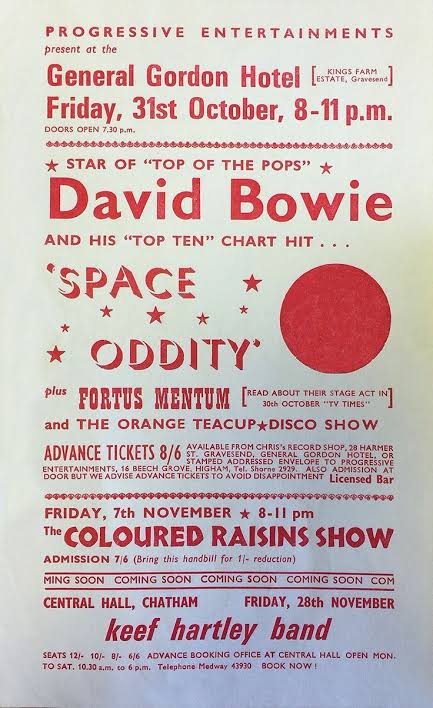
Of course, Bowie could nearly always be said to have been in a state of transition throughout his career. If folk and folk-rock aren’t the first styles his music is associated with, they were very much in evidence in the year or so between his association with Deram Records ended (early 1968) and he began recording for Mercury (about mid-1969). As he didn’t release any discs in 1968, it’s a rather hazily documented period, though numerous demos on the first two CDs of his Conversation Piece box fill in much of that gap.
By far the most interesting of such relics from the period preserved in the archive is a twenty-song list tagged as originating from a December 6, 1968 performance at the Drury Arts Lab in London. This is reprinted in the liner notes to the Conversation Piece box, but I feel it’s worth discussing here as not everyone wants to lay out for that expensive compilation.
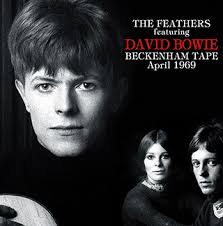
This was a gig by Feathers, the short-lived trio Bowie headed that also included his girlfriend of the time, Hermione Farthingale, and guitarist/singer John Hutchinson, who’d played with Bowie in the full rock band David fronted in 1966, the Buzz. There seem to have been two sets, as the handwritten list is divided into two parts with ten songs each. As a minor point of uncertainty, in the Conversation Piece box, this is identified as originating from performances at the Beckenham Art Lab (more commonly named as the Beckenham Arts Lab, plural), not the Drury Arts Lab.
The first part has these ten songs:
1. Let Me Sleep (aka Let Me Sleep Beside You, recorded by Bowie for Deram on September 1, 1967, and not released until the 1970 compilation The World of David Bowie)
2. Conversation Piece (B-side of 1970 single “The Prettiest Star”)
3. My Death (written by Jacques Brel, often performed by Bowie in the late 1960s and early 1970s, and not recorded by Bowie in the studio, though live versions from 1972-73 appear on archival compilations)
4. Paradise Almost Lost (a poem by Joseph Newman, uncle of famous actor Paul Newman, recited to musical backing by Biff Rose on his 1968 album The Thorn in Mrs. Rose’s Side. That album also contains “Fill Your Heart,” which Bowie would cover on his 1971 album Hunky Dory)
5. Occasional Dream (aka An Occasional Dream, which would appear on his 1969 album David Bowie)
6. Old Man
7. Lover to the Dawn (not recorded by Bowie in the studio, though a couple demos by him and Hutchinson—the first undated though likely from around early 1969, the second from around mid-March 1969—appear on Conversation Piece, and some of the lyrics and melodies resurfaced on the 1969 David Bowie album in “Cygnet Committee”)
8. Mask
9. Here Am I
10. Theme
The second part has these ten:
1. Janine (appears on the 1969 album David Bowie)
2. Space Oddity (obviously, to be his 1969 hit, and also on David Bowie)
3. London Bye Ta-Ta (first recorded in the studio for Deram on March 12, 1968, and re-recorded in January 1970, but not released at the time. The 1970 version later appeared on the Sound + Vision box, and the 1968 version is on the two-CD expanded edition of Bowie’s 1967 album (confusingly, like his 1969 album, titled David Bowie). A late-‘60s demo version is on Conversation Piece, and a May 13, 1968 BBC version is also available)
4. When I’m Five (also performed at the May 13, 1968 BBC session, which would appear on the soundtrack to his 1969 Love You Till Tuesday promotional film. A demo with John Hutchinson from the circa mid-March 1969 session is on Conversation Piece)
5. Letter to Hermione (appears on the 1969 album David Bowie)
6. Them Poems
7. Carpenter (aka the Tim Hardin song “If I Were a Carpenter,” a hit for Bobby Darin. A handwritten note on the setlist makes it clear this was based on Darin’s version)
8. Winter Lady (from Leonard Cohen’s debut album Songs of Leonard Cohen, released at the end of 1967)
9. Love at Lunchtime
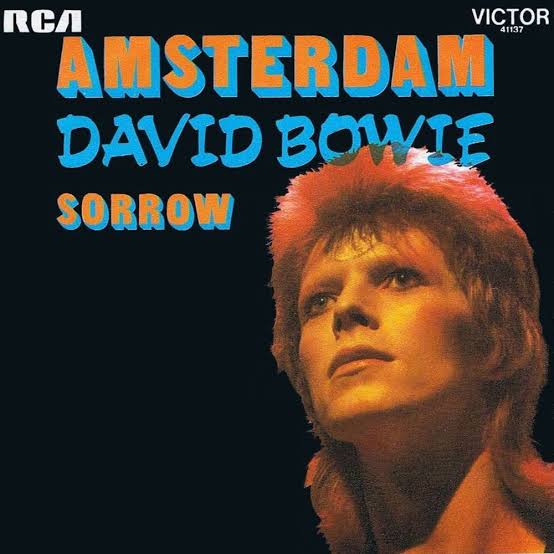
10. Port of Amsterdam (aka Amsterdam, a Jacques Brel song often performed by Bowie in the late 1960s and early 1970s. A 1971 studio version was used on the 1973 B-side to “Sorrow”)
As for some general observations about the song selection, Bowie had definitely left his Anthony Newley phase behind. There’s just one song that he had recorded in the studio prior to 1968. Although “Let Me Sleep Beside You,” “When I’m Five,” and “London Bye Ta-Ta” were recorded for Deram and/or the BBC in winter/spring 1968, they’re not as indebted to non-rock musical theater as most of his Deram output was. “Let Me Sleep Beside You” verges on Donovan-like rock. The overly cutesy “When I’m Five” almost sounds like it’s from a children’s music folk album, and was likely dropped from his repertoire after early 1969. Bowie certainly tried a bunch of times with “London Bye Ta-Ta,” which perhaps has some echoes of his musical theater phase, but ultimately it wasn’t all that strong a song, or at least not as strong as the best of what he was coming up with for his 1969-70 albums.
It also seems that Bowie was zeroing in on the best of his compositions at the time. Demos of more than half a dozen others from around 1968 and late 1969 are on the first disc of Conversation Piece, and none are that good. None of them appear on these setlists, either.
The most intriguing items, of course, are the half dozen whose origins are uncertain or unknown. Here are some guesses, some wild, as to their sources:
“Old Man” could be the Bryan MacLean song of that name that appeared on Love’s classic 1967 album Forever Changes. Bowie was certainly a Love fan, as Love leader Arthur Lee once remembered David sending Arthur his first (1967) self-titled album with a letter asking for help with his songs. (Lee didn’t listen to anything else on the LP after playing “Uncle Arthur,” which he didn’t like.)
“Mask” probably wasn’t a song, but a mime, and probably the same one about a mask Bowie performed in the Love You Till Tuesday promotional film.
“Here Am I”: Could this have been an early title for “Space Oddity,” which has a couple key lines beginning with those words? If so, was the song already considered special enough to be performed in both of these sets, with the song given its proper title for the setlist for the second set?
“Theme” could have been almost anything. An instrumental to conclude the first set, perhaps?
“Them Poems” is a strange title, and certainly not related to the great mid-‘60s rock group of that name led by Van Morrison. In the entry for this December 6, 1968 show in Kevin Cann’s David Bowie: Any Day Now: The London Years: 1947-1974, John Hutchinson remembers doing a couple short poems and “being quite embarrassed having to read poems out, sitting on a stool.” These might have been poems by Roger McGough of the Scaffold, as he also remembered Bowie performing McGough’s poem “At Lunchtime—A Story of Love.”
“Love at Lunchtime”: Hutchinson’s memory makes this certain it’s Bowie reciting Roger McGough’s poem “At Lunchtime—A Story of Love.”
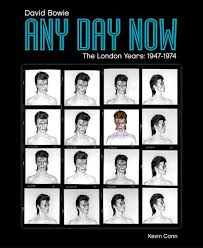
According to Cann’s book, the concert also included “Life Is a Circus,” a cover of a song by the obscure group Djin, demos of which are on Conversation Piece. The same source also states Feathers also did the Beatles’ “Strawberry Fields Forever” and a song titled “The Princes Parties.” Although Cann’s book identifies this as a Bowie composition, in my interview with John Hutchinson in 2014, he told me the title is actually “The Prince’s Panties.” A song of that name was on the 1968 album Phonograph Record by Mason Williams, who had a big instrumental hit in the US and UK that year with “Classical Gas.” That’s almost certainly the song performed by Feathers.
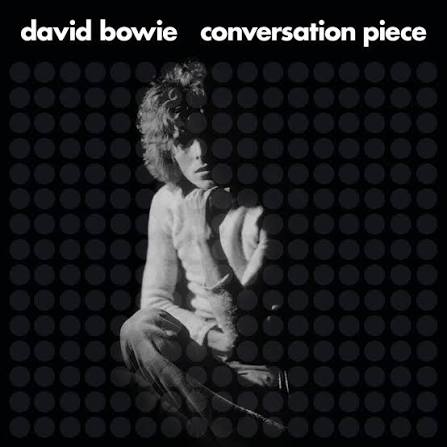
This is a pretty eclectic setlist (or setlists, if you prefer), with material more related to folk, or at least folk-rock, than rock, as befitting an acoustic trio. Some mime and poetry was thrown in, and would be unlikely to make the transition to vinyl (as indeed they wouldn’t, mime being impossible to represent on record in any case). The core of the repertoire that would feature on his 1969 album is already in place a half year or so before work would start on that LP. “Space Oddity,” “An Occasional Dream,” “Janine,” and “Letter to Hermione” would all be on that album, and all be among that record’s strongest songs; “Conversation Piece,” another quality composition, would be on a B-side not long afterward. Some more marginal Bowie originals wouldn’t make the cut for official release, but he’d keep Brel covers in his onstage repertoire, and as noted release one (“Amsterdam”) on a 1973 B-side.
It’s interesting Bowie covered Tim Hardin’s “If I Were a Carpenter” and Leonard Cohen’s far less known “Winter Lady” at this time, but it’s doubtful these were considered for inclusion on his studio releases at a time when he was trying to establish himself as a major singer-songwriter in his own right. Perhaps because Biff Rose was far less known than Hardin or Cohen, he felt it appropriate to include a Rose song on Hunky Dory. No such honor would befall Mason Williams’s “The Prince’s Panties,” however, which would have been far more of an oddity than even Rose’s “Fill Your Heart.”
The Bowie archive also has a few typewritten pages that seem to have been an attempt by Bowie or someone else to catalogue/list all the songs he performed onstage from 1964-70. The list of songs performed in the late 1960s is a little confusingly organized—there’s a grouping of December 1967 songs performed by Feathers, although Feathers didn’t form until around mid-1968, for example. In any case, the numbers listed for the late 1967-70 era, which don’t seem to take the Drury Lane performance into account, don’t have many surprises.
Dates of December 1967 and August 1968 precede a group of eight songs that seem more likely to date from August 1968. Perhaps these were performed at the Marquee Club in London, as the dateline on the bottom reads “Marquee Aug 1968,” and Bowie had a show there on August 1 of that month. This included a song from his 1967 album, “Sell Me a Coat”; “When I’m Five,” “Amsterdam,” and “Life Is a Circus,” which were in his repertoire at the time of the Drury Lane concert: “Next,” another famous Jacques Brel composition, which was on the second album by another significant influence on Bowie, Scott Walker; “Alabama Song,” the standard most famous as done by Lotte Lenya and the Doors, and which Bowie would record in 1978 for a 1980 B-side; and “Ching-A-Ling,” apparently not performed at Drury Lane, but recorded by Bowie on August 24, 1968, and also demoed with John Hutchinson around mid-March 1969.
The main outlier is “Lady Midnight,” which has been identified as a song from Leonard Cohen’s second album, Songs from a Room. That would have had to have been learned from a publishing demo or some such source back in 1968, since Songs from a Room wasn’t released until April 1969. Assuming this was a Leonard Cohen song and Bowie did cover it onstage at some point, along with his version of “Winter Lady,” it testifies to the considerable influence Cohen’s work must have had on David.
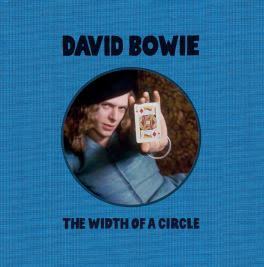
A grouping of songs under the heading “performed solo 69-70” doesn’t offer many surprises, though it reaches as far back as his Deram efforts “Let Me Sleep Beside You,” “Karma Man,” and “When I Live My Dream.” It also includes some songs like Biff Rose’s “Buzz the Fuzz” and “Threepenny Pierot” that didn’t make it onto his official releases at the time, though versions are on The Width of a Circle, the two-CD comp of 1970 odds and ends. The one oddity is Bob Dylan’s “Don’t Think Twice, It’s Alright.” Certainly Bowie knew of and admired Dylan; he even wrote “Song for Dylan” on Hunky Dory, of course. “Don’t Think Twice, It’s Alright” seems like a folk revival throwback to throw into a set around 1970, though, at a time when Bowie was moving into more original rock.
Trying almost anything he could to advance his career, including getting other artists to record his compositions, Bowie was certainly writing a lot of songs during this period. As noted earlier, the first disc of the Conversation Piece box has a bunch that don’t appear on surviving setlists; the Bowie archive has lyrics to a few others. This continued even after he’d finally begun rocketing to superstardom in 1972 with the Ziggy Stardust album. Here’s as good a time as any to note one such instance that pops up in the archive, and which I’m not sure I can fit into another post.
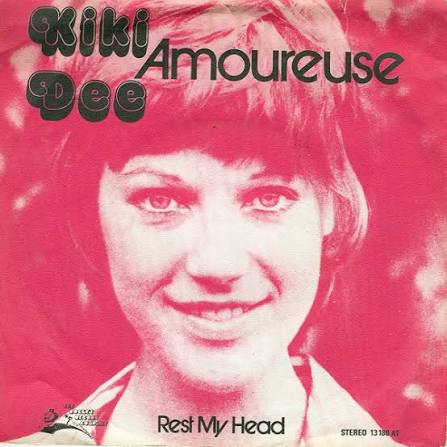
In a letter dated November 4, 1973, Kiki Dee writes that “I was really pleased to get your letter the other day. The song you sent I already know and I have it planted in my mind for future recording or live work.” Dee had been making records for even longer than Bowie (since 1963) and taken even longer to get a hit, with “Amoureuse” entering the UK Top Twenty the month after this letter. It wouldn’t be too surprising if Bowie and Dee had crossed paths before either had hit records, as Bowie had with another British woman singer who’d put out a bunch of hitless singles, Lesley Duncan, whose “Love Song” he and Hutchinson did on their circa mid-March 1969 demos. Dee sang backup vocals on an early attempt at one of Bowie’s early flop singles, “I Dig Everything, in June 1966, which doesn’t necessarily mean they were in the studio at the same time.
But what was the song Bowie sent Dee in 1973? Was it something he’d already released, a la “The Man Who Sold the World,” which Lulu would cover for a British hit in 1974? Was it something he would release in the future, or even would never release, or even have written specifically for Dee? I can’t find any details. According to David Bowie: Any Day Now: The London Years: 1947-1974, in 2003 Dee recalled, “He wrote to me saying he liked [“Amoureuse”] and he sent me a song. I think at the time I was so thrilled to have a hit record I didn’t appreciate how fabulous it was to hear from him.” Could it have been that special if Dee didn’t record it or remember more specifics?