Anthony Newley’s influence on many of David Bowie’s early recordings has often been commented upon, and was no secret even when they were released. Those unfamiliar with Newley, and indeed unfamiliar with Bowie’s work predating his 1969 hit “Space Oddity,” are often baffled upon hearing what Bowie recorded for Deram Records between late 1966 and early 1968. Most of that was cut between late fall 1966 and late winter 1967, an output concentrated into just a few months.
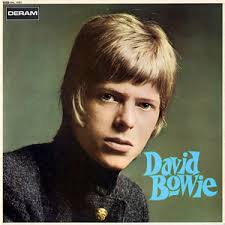
There’s not just little too recognizably Bowie to listeners of his subsequent catalog, but little rock influence at all. It’s precious, dainty pop with a very heavy bent toward theatrical musicals. There’s a prevalence of story songs, whether about a “Maid on Bond Street,” a “Little Bombardier,” “Uncle Arthur,” or “The Laughing Gnome,” to take just a few examples. Only on the brooding, haunting “The London Boys,” depicting a down-and-out mod, does Bowie seem to be singing from deeply personal experience and creating a memorable mood. Accurately described by Roy Carr and Charles Shaar Murray in David Bowie: An Illustrated Record as “probably the most moving and pertinent work that Bowie produced prior to ‘Space Oddity,’” it’s the only strong hint of his future originality.
Elsewhere Bowie often comes off as a sub-Newley singer-songwriter, often even sounding considerably older than he would from the late 1960s through the 1970s. His singing is mannered and melodramatic, and not in a glam rock fashion, but in an old-fashioned fashion. That doesn’t have much appeal to rock fans, and probably not too many Newley fans, since Newley was much more accomplished in that genre, and in fact one of its main exponents.
Bowie didn’t do this under pressure from management and a record company. John Hutchinson played guitar and sang with Bowie in three different eras—1966, when Bowie was playing mod rock with the Buzz; 1969, when he and Bowie had a folky duo; and 1973, when Hutchinson played guitar with Bowie on tour. He told me:
“He liked Anthony Newley, ‘cause Anthony Newley used to sing in his own accent, in a kind of London accent. And David realized that when he sang in his London accent, he was quite a lot like him. I think he liked the theatrical kind of thing as well, and Anthony Newley was known as an actor as well as a singer. Certainly Anthony Newley himself was one of David’s favorites, and he was quite happy that people said, ‘Oh, he sounds a bit like a young Anthony Newley.’”
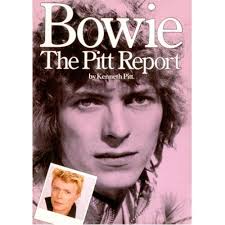
According to early Bowie manager Ken Pitt’s memoir Bowie: The Pitt Report, the resemblance didn’t escape the attention of “his very first album review. Critic Allen Evans said: “Here’s a Cockney singer who reminds me of Anthony Newley and Tommy Steele, which can’t be bad. He sings with a mild beat, about ordinary things like a Rubber Band, Uncle Arthur, and about a romance which started on Sunday and he promised to Love You Till Tuesday. Or an intelligent protest song called We Are Hungry Men. All very refreshing…and then you notice that this nineteen-year-old David Bowie [who was actually twenty when his self-titled debut LP was released on June 1, 1967] has written all fourteen tunes on the album! Yes, we have another Anthony Newley here all right. A very promising talent. And there’s a fresh sound to the light musical arrangements by David and Dek Fearnley.”
What of Newley’s and others’ reaction, if any, to the young upstart pseudo-Newley, and Bowie’s own thoughts about Newley at the time and afterward? A few items in the newly opened Bowie archive, part of the David Bowie Centre in London’s Victoria & Albert East Storehouse branch, sheds a little light on this.
The archive has a few of Bowie’s set lists from 1964-69, and it seems he actually covered very few Newley songs in concert. In what looks like a reconstructed summary list of the songs he did during these years, only one is listed. That’s one of the most famous, and perhaps the most famous, Newley song (which he wrote with Leslie Bricusse), “What Kind of Fool Am I?” It’s listed among numerous tunes he performed with the Buzz in early 1966, alongside all kinds of material, including Bowie originals; Buddy Holly hits; soul classics by Sam Cooke, Mitch Ryder, Marvin Gaye, and others; and another theatrical standard, “You’ll Never Walk Alone.” Although typewritten, one guesses this was typed or dictated by Bowie, since “Newly” is spelled out as the source for “What Kind of Fool Am I?”—not the only time he’d misspell his hero’s name.
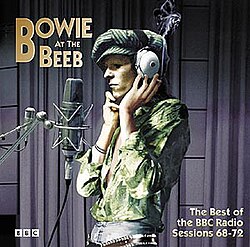
Notoriously, Bowie had failed an audition for BBC radio (backed by his group of the time, the Lower Third) in late 1965, a panel giving him five thumbs-downs to two thumbs-ups, sometimes with brusquely dismissive criticism. (The panel’s verdict notes are in the archive, and have surfaced in full elsewhere.) However, he passed his BBC audition in February 1968, based on what a February 22 letter terms a “trial broadcast” for the Top Gear radio program taped on December 18, 1967. That was actually broadcast on December 24, and the five tracks were released on a deluxe edition of Bowie’s first album in 2010. (These five songs were “Love You Till Tuesday,” “When I Live My Dream,” “Little Bombardier,” “Silly Boy Blue,” and “In the Heat of the Morning.”)
As for the Bowie-Newley connection, however, the BBC panel giving him a pass (by a majority of four-to-one) also noticed Newley’s influence. In fact, in a letter from February 1968 in the archive giving the detailed comments by the unnamed panelists, all four of the yay-sayers compared him to Newley. They said:
“A singer whose tone and intonation one cannot help listening [sic; probably the intended word was “comparing”] to Anthony Newley. He is nevertheless very distinctive in his own right giving just the right amount of feeling and emphasis to these songs that he sings and also writes. An excellent singer who deserves much more radio exposure.”
“Has a good voice reminiscent of Tony Newley which is probably not suitable to a show which is strictly ‘pop’ but would be good on any shows where there was an adequate backing orchestra.”
“More like Tony Newley than Tony Newley—it’s excellent material and he is confident and nicely personable.”
“Good professional performance with an Anthony Newley-style voice. Confident approach with good attack on lighter numbers.”
It appears that someone named Jimmy Grant gave this brief summary on February 15, 1968: “A singer compared to Tony Newley who gives effective performances of his own compositions.”
All these make for a wealth of blatant Newley comparisons, though that didn’t seem to put them off liking and approving Bowie. And what did the one nay-sayer say?
“Fetter-type singer [probably referring to Broadway lyricist Ted Fetter], using mostly his own material. He has no voice to speak of and relies upon said material. Lovely arrangements, but these may have nothing to do with the composer! I feel that he is lacking in the essential charm to get what he is trying to do across.”
Was Newley himself aware of Bowie at the time? It seems doubtful, as Bowie was selling few records and making few live appearances during this period. Ken Pitt does write in The Pitt Report that around the time of the first album’s release, “perhaps Newley was now heartily fed up with reading and hearing about his alleged clone for when Essex Music, with whom he was associated, sent him a collection of David’s songs he displayed little interest.” Yet according to Kevin Cann’s David Bowie: Any Day Now: The London Years 1947-1974, “For his part, Newley only became aware of Bowie’s interest in him many years after the release of [the debut album] David Bowie.”
Cann also gives this quote from Newley: “The first I knew of his respect for my work was in an article, I believe in Time magazine, in which he mentioned how much my early work as a rock’n’roll singer had been an influence.” It might seem odd for Newley to refer to himself as a rock’n’roll singer, but he did cover, and not too well, the Beatles’ “I Saw Her Standing There,” on a US single in October 1963. This was one of the few instances of a Lennon-McCartney cover gaining US release before the Beatles had their first Stateside hit (“I Want to Hold Your Hand,” just three months later), though as it wasn’t issued in the UK, it’s very doubtful Bowie heard it.
In the same quote Newley went on to note, “He was most gracious in the Time article and I was very touched and wrote him a letter to which I didn’t receive an answer, but I presumed he was very busy.” This might be a letter in the archive from Newley to Bowie, dated August 17, 1973, thanking him “for the beautiful flowers…We all hope you liked The Good Old Bad Days [a 1972 musical Newley co-wrote with Leslie Bricusse], and are very touched that you thought of us.” Although Cann wrote that “the two entertainers never met,” this seems to indicate Bowie might have seen or at least been invited to a performance of The Good Old Bad Days, and certainly sent Newley flowers at the time.
While Bowie moved away from Newley-inspired material even by 1968, and into folk-rockish singer-songwriting by 1969 and hard glammish rock by 1970, he hadn’t forgotten his early inspiration. The archive has two pages of handwritten notes, almost certainly from 1971, that seem intended for possible liners to his ’71 album Hunky Dory, or perhaps a press release for that record. Like the Mothers of Invention’s Freak Out and Buffalo Springfield’s Again, it lists many of his influences and people he personally encountered. Seven names down the middle of three columns is “Anthony Newly,” right below Iggy Pop. Bowie misspelled some other names of his prime influences, as a Velvet Underground co-founder’s name is spelled “John Cayle” elsewhere on the list, and their early manager’s name as “Andy Warhole.”
Another letter in the archive, from July 17, 1983, has Newley inviting Bowie to see Newley’s musical Chaplin in Los Angeles in August of that year. “No heavy number, just if it would be fun for you,” he assures David, who at this time was at the peak of his superstardom, as his recently released Let’s Dance was on its way to becoming his biggest album, eventually selling more than ten million copies. As evidence of how the tables had turned from the days when Newley was a big name and Bowie a no-name, Anthony added, “You could watch an old singer try for a comeback!”
Bowie paid Newley explicit tribute in an undated printed page in the archive. “Anthony Newley helped me find my voice,” Bowie wrote. “Unfortunately it was his voice that I found. For the full year of 1967 I was convinced I was his natural inheritor. I have the album to prove it, my first on the now defunct Deram record label, and because of Mr. Newley’s huge influence, eccentric and ambitious.
“His quirky and comedic film persona had caught my attention ever since I saw him as the Artful Dodger in Oliver Twist. But it was the weird and off-the-wall 1960 TV series The Strange World of Gurney Slade that he directed and in which he starred, that galvanized me completely. Here was an ‘outsider,’ a misfit who saw the world around him through almost dada eyes, having mad conversations with inanimate objects. I was just 13 and to me and some of my artier friends at school, it was the zenith of hip. It was just too out-there for the comfy BBC and only lasted one season. It seems now, looking back, that its focus, picking holes in the conventional and the suburban, anticipated the wave of TV satire which was to sweep the UK later in that decade.
“One ability seemed to follow hot on the heels of another from that moment. A major film actor, he broke away for a while to be a Pop Star. Then he was on the London stage with Stop the World. This was a turning point for me. Mr. Newley had written all the songs. I could do that. I woulddo that. I could write musicals. And I’d sing in a London accent. Well, the nearest to a musical I ever got was The Rise and Fall of Ziggy Stardust and the Spiders from Mars. But even there the length of the title suggests to me that I was indebted to Mr. Newley by way of his 1969 film Can Hieronymus Merkin Ever Forget Mercy Humppe and Find True Happiness?
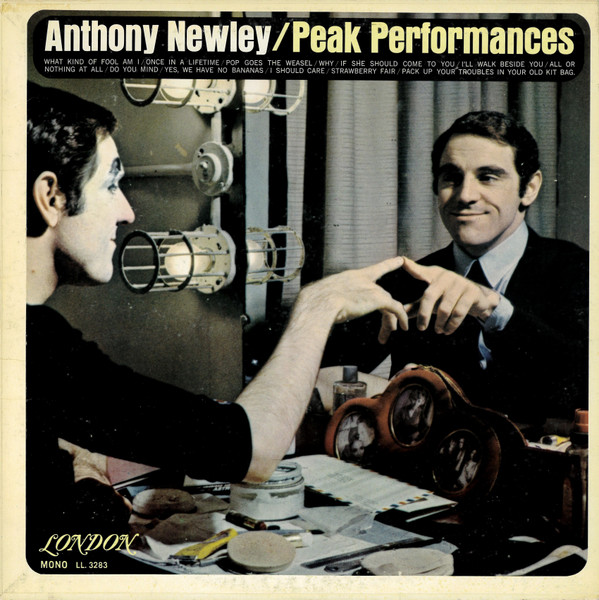
“There’s one album cover of Mr. Newley’s that will remain an indelible image for me. On the front of Peak Performances Mr. Newley sits in his dressing room in front of his mirror. He is made up in the Littlechap clown face. Staring back at him from the mirror is his own unmade up face. I think that the first time that I saw that cover, the basic seed of ‘self-re-invention’ planted itself in my psyche.
“In Paris, around 1998, I found myself eating in the same restaurant as Mr. Newley. It was a nook and cranny kind of place so we couldn’t actually see each other. A waiter came over to me and informed me that Mr. Newley was celebrating a birthday with a large group of family and friends and would I care to join them. As sometimes happens with me on these occasions I was immediately waylaid and crippled by shyness, the prospect of actually meeting a man who had had such an impact on my youth completely froze me, and I declined to go and join the party with some flimsy excuse or other. It was not too long after this that I read of his death in the papers and a wave of regret and sorrow swept over me. It’s too late now of course, but if you can hear me, Mr. Newley, I would like you to know that without the ideas that you led me to, way back when, little of what I dreamed I could do would have reached fruition. Please don’t think bad of me if I now say what I should have said a couple of years ago, happy birthday Mr. Newley, a happy birthday to you.”